

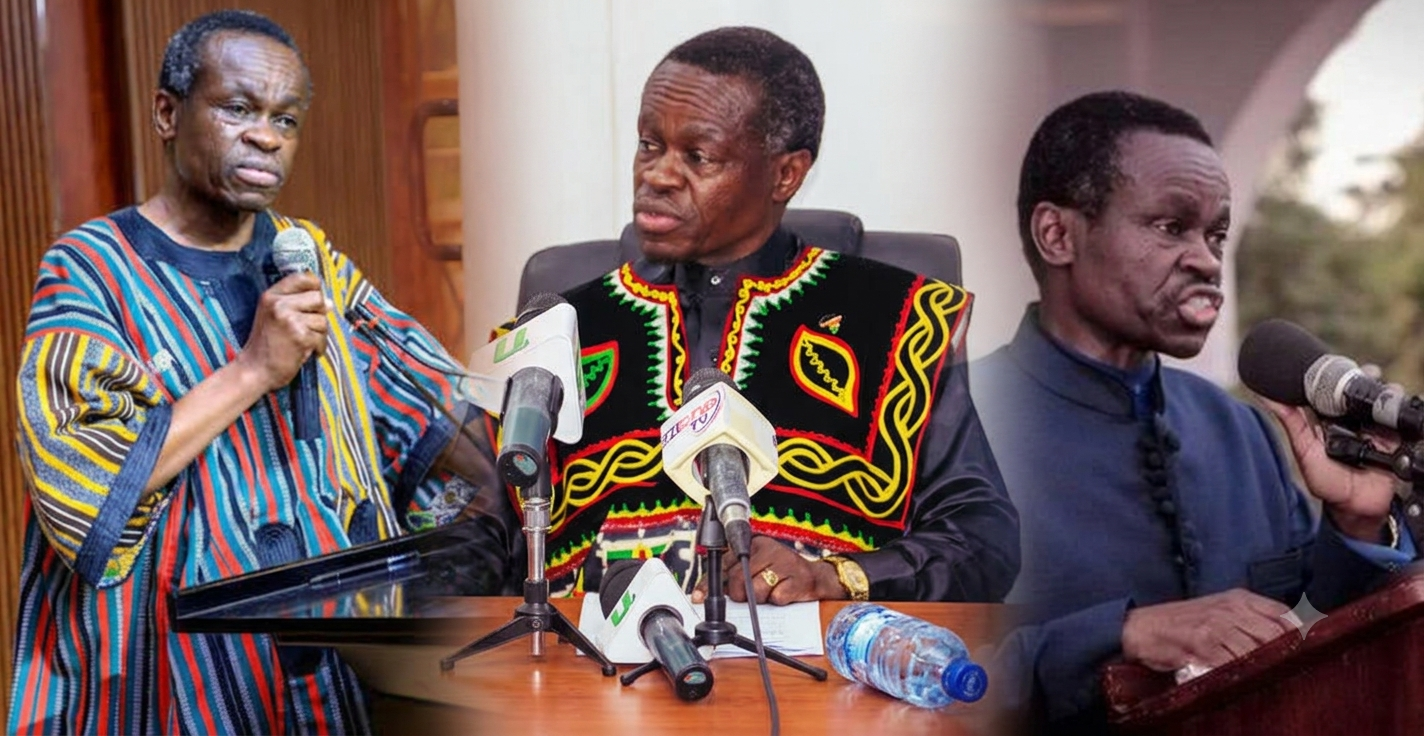
While PLO Lumumba’s criticism is aimed almost exclusively at South Africa—condemning the country’s handling of undocumented African migrants and calling for diplomatic action—his remarks do not meaningfully engage with the conditions in several African countries that continue to drive irregular migration into South Africa.
By Themba Khumalo
PLO Lumumba’s recent comments on South Africa’s handling of African migrants have reopened a long-running and difficult debate about migration on the continent.
In his remarks, he described South Africa as “a danger to African unity” and called upon African governments to recall their ambassadors.
His comments are among his strongest public criticisms of how South Africa deals with undocumented migration.
The reaction has not only been about what he said, but also about what his words imply. More importantly, they have sparked many questions in South Africa about migration, responsibility, and the conditions driving people to move across borders in large numbers.
His comments have drawn attention not only because of what they say, but also because of what they leave unsaid. While placing South Africa under intense scrutiny, they also raise broader questions about why migration into the country continues at such a scale.
Lumumba’s standing and why his comments carry weight
Lumumba is widely known in South Africa as a strong Pan-African voice, particularly on issues such as governance, corruption, and Africa’s development challenges.
Over the years, his commentary has often resonated with people concerned about inequality and weak state performance across the continent.
It is partly because of this standing that his recent comments have drawn close attention. For some, they confirm longstanding concerns about how African migrants are handled in South Africa.
For others, they raise a different issue: whether his analysis fully accounts for why so many people are moving to South Africa in the first place.
What he is arguing
At the centre of Lumumba’s comments is a clear concern: that South Africa is failing to address the issue of African migrants with dignity and that this undermines the idea of African unity.
He frames the issue not just as an immigration matter but as a moral one. South Africa, in his view, carries a special responsibility because of the support it received from other African countries during the struggle against apartheid.
From this perspective, how it handles African migrants today becomes a test of its commitment to Pan-African solidarity.
His call for African governments to recall their ambassadors is meant as a form of diplomatic pressure, designed to force attention on what he sees as a worsening situation.
The questions his comments leave open
One of the questions raised by his comments is how he reaches the conclusion that South Africa is a “danger to African unity” and what evidence or comparison that judgment is based on.
The statement is made firmly, but the reasoning behind singling out South Africa is not fully explained.
This matters because South Africa is not the only country on the continent facing serious social and political challenges.
In several African states, there are ongoing conflicts, weak governance, and economic hardship that have led to large numbers of people leaving their countries.
Against that background, an important question emerges: is South Africa being assessed only on its own actions, or is it also being used as a symbol of wider frustration about migration and inequality across the continent?
The bigger picture behind migration
Another part of the debate that cannot be avoided is what is happening in the countries people are leaving.
Many migrants who arrive in South Africa are escaping unemployment, poverty, weak public services, and, in some cases, political instability or conflict.
For many, leaving is not a preference but a necessity, driven by difficult conditions at home.
This does not reduce the importance of how South Africa handles migrants within its borders. But it does highlight that migration is not driven by South Africa alone. It is also shaped by conditions in countries of origin.
Any assessment that focuses only on the receiving country risks overlooking the circumstances that compelled many migrants to leave home in the first place.
Why South Africa has become the destination
A further question often raised in public debate is why South Africa, in particular, attracts so many migrants.
The answer lies in relative opportunity. Compared to many other African countries, South Africa has a larger and more diversified economy, stronger institutions, better infrastructure, and more developed public services. It also has established migrant communities, which makes relocation easier.
Even with its serious problems—high unemployment, inequality, and pressure on public services—South Africa still offers more opportunities than many neighbouring states.
A difficult reality inside South Africa
At the same time, there is another side of the story that needs to be acknowledged.
Many ordinary South Africans feel pressure from unemployment, struggling services, and limited economic opportunity.
These frustrations are real, even if they are sometimes expressed in ways that are unacceptable.
Recognising those concerns is not the same as endorsing them. It is an acknowledgement that effective public policy begins with understanding the realities citizens experience, even where those perceptions are contested.
This is why the issue cannot be seen from only one angle. It involves both the handling of migrants and the conditions that shape how local communities respond.
Responsibility and balance
The debate around Lumumba’s comments also raises a broader question that extends beyond South Africa: what responsibility rests with governments whose political and economic conditions have contributed to sustained outward migration?
South Africa has a duty to enforce its immigration laws fairly and protect the dignity of everyone within its borders.
At the same time, it is fair to ask what responsibility lies with other African states whose economic and governance conditions are contributing to large-scale migration.
This is not about shifting blame. It is about recognising that migration pressures are shaped on both sides of the border.
Beyond symbolism
Lumumba’s call to recall ambassadors is one of the strongest diplomatic statements made by a leading Pan-African figure in recent years.
Whether such a step would resolve the underlying causes of migration is another matter.
Diplomatic protest may draw attention to a problem, but it cannot address the conditions that cause people to leave their own countries in the first place.
Nor can it resolve the pressures facing countries that receive large numbers of migrants.
Those challenges require more than symbolism. They require stronger governance, economic opportunity, regional cooperation and effective immigration systems across the continent.
What remains unresolved
Lumumba is right to insist that African migrants deserve dignity, protection and equal treatment before the law. These principles are fundamental and should never be compromised.
The harder question is whether these very principles alone, are enough to address the migration crisis facing South Africa.
His comments place strong focus on how South Africa handles migrants, but say less about the conditions in other African countries that continue to drive people to leave.
Until both sides of that equation receive equal attention, the debate remains incomplete.