

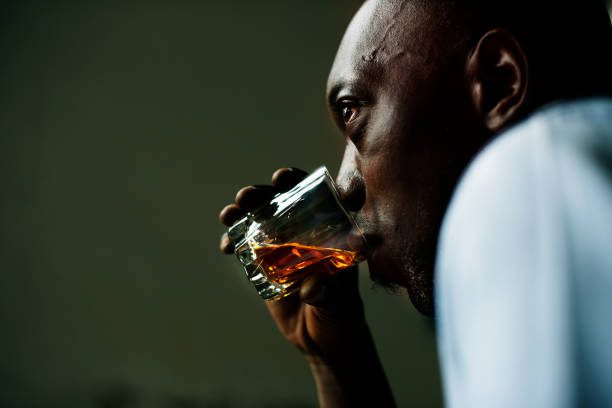
The bottle promised Gogo Bathini Mbatha courage but delivered something far more dangerous: a mouth without brakes. He recalls how alcohol transformed his natural gift for humour into hurtful recklessness, and how sobriety finally forced him to confront the fears underneath.

By Gogo Bathini Mbatha
There is a distinct, agonising sort of shadow that lives in the unknown.
When you are standing on the edge of a blank tomorrow without a single drop of liquor to soften the contours of reality, that shadow appears vast enough to swallow a person whole. It is an unnerving, chest-tightening kind of terror — the realisation that once the chemical fog clears, you are left entirely naked to your own thoughts, stripped of every piece of armour you spent years perfecting.
For the longest time, my solution to that shadow was as predictable as it was destructive. Staying sober was the true phantom lurking in the dark corners of my mind, a prospect so utterly terrifying that I could not bear to look it in the eye for even a solitary hour.
The moment that cold prickle of panic surfaced at the back of my neck, I would immediately move to drown it in booze. A few heavy, unmeasured pours of whisky and suddenly I was draped in the cheap, synthetic velvet of liquid courage.
It was a grand illusion, of course. Alcoholic courage is never genuine bravery; it is a volatile, reckless bravado born of desperation, the kind that leaves a wide swathe of scorched earth in its wake.
That very same false confidence gave me the audacity to fracture relationships I held dear, severing deep bonds with people who had offered nothing but warmth and patience. At family gatherings, whenever the dread of meeting new faces or navigating social expectations began to creep up my spine like ice, my answer was always to reach for the bottle.
Drenched in my own hollow fearlessness, I would step ruthlessly over people’s feelings, my tongue untethered and razor-sharp, scattering careless, hurtful words across the room as if they carried no weight at all.
Yet, if I pull back the curtains and look deep into the archives of my childhood, long before the bottles took over my days, the unknown was not always a monster. Back then, joy came naturally. I was the bright spark in the room, the township comedian who could effortlessly turn any simmering tension into belly laughter — whether at home around the kitchen table, in the schoolyard, or on the dusty street corners of our neighbourhood.
Laughter was the currency of my youth, and humour was my natural language. I possessed an innate instinct for creating an environment where everyone could breathe a little easier. Had anyone possessed the foresight to tell me then that a person could build a life and earn an honest living simply by making people smile, I would have chased that dream to the ends of the earth without a second thought.
When alcoholism took the steering wheel, however, it corrupted that gentle gift. The laughter turned sour, and the light-hearted banter acquired a jagged, dangerous edge. In my drunken enthusiasm, I routinely crossed lines I had no business even approaching, mistaking cruelty for wit and boundary-crossing for charm.
But here lies the quiet miracle of the human spirit: while the liquor may have tainted the rhythm of my humour, it could never drain it from my marrow. Wit still runs through my veins like an indelible river, an enduring part of who I was created to be.
Now, as I navigate this long, unvarnished road of sobriety, I flatly refuse to become a dour, miserable soul sitting in the corner, nursing a bitter cup of black coffee while looking down my nose at the world. I have no desire to parade around as though I’ve been awarded some grand “Sobriety Grammy”, acting as if staying clean makes me a saint among mortals. Sobriety is not an exercise in self-righteous martyrdom; it is merely the fundamental baseline of living truthfully. It is choosing to sit with oneself without an escape hatch.
I still carry the heavy memory of those dark days when I was genuinely terrified to glance at my own reflection in the bathroom mirror. I was a haunting sight to behold. Staring back at me through the glass was a face worn hollow by excess, marked by wide, bloodshot, cow-like eyes that seemed entirely detached from humanity. In those moments, I looked less like a person and more like an inkabi — a cold, menacing figure emerging from the twilight, carrying the heavy aura of someone capable of unspeakable things.
I remember the morning a relative looked at me, shook their head in mournful disbelief, and remarked, “Gogo, you look like a real traditional healer now… You are downright terrifying.” They mistook the sunken features and ominous stillness for spiritual gravity, but I knew the brutal truth. What they were witnessing was not the solemn burden of an ancestral calling; it was the raw, swollen ruin of textbook Phuza Face.
It was the unmistakable, unforgiving stamp of chronic alcohol abuse etched directly into my skin, a physical manifestation of a soul in freefall.
Today, the swelling has subsided, and those hollow, menacing eyes have vanished from the mirror. The monster in the glass has finally vacated the premises. Yet, the work is far from finished. I am still required to face the unknown every single morning, and I still have to stand toe-to-toe with my deepest, most intimate anxieties without a glass of whisky to hide behind or a bottle to soften the blow. It is often an uncomfortable, raw, and deeply unsettling experience to feel every emotion without being able to hide from any of them.
But for the very first time in my life, I am not running away. I am standing my ground, clear-eyed, steady, and entirely sober, ready to meet every single shadow head-on as the morning light breaks.
Gogo Bathini Mbatha: Founder of Sober Beings/Traditional Healer/Researcher/Spiritual Educator