By Themba Khumalo
Every June 16, the South African government rolls out the banners, tunes the sound systems, and dusts off the predictable speeches to commemorate Youth Month.
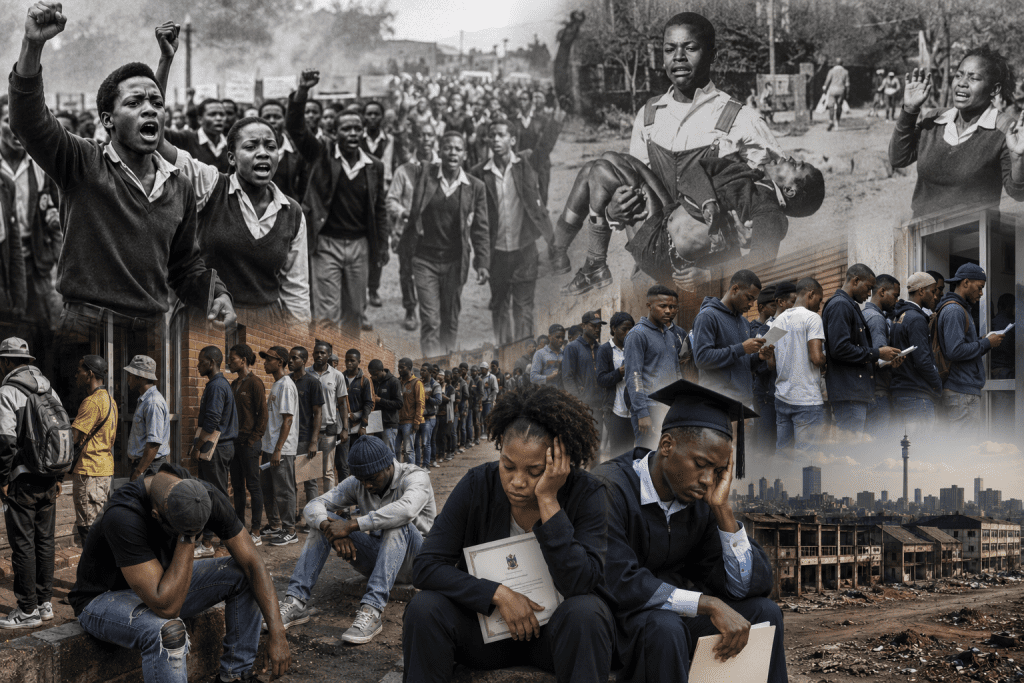
We are told to look back at Wednesday, 16 June, 1976, to draw inspiration from the brave schoolchildren of Soweto who marched against a brutal system. Yet, there is a sickening absurdity to this annual ritual.
We look back because we are utterly terrified of looking at the present. We toast to the departed of 1976 because it allows us to ignore the slow, systemic economic execution of the living in 2026.
To celebrate “youth empowerment” in a country where the young are treated as a surplus demographic is not just ironic; it is an insult.
The reality is that South Africa has converted its youth into a lost generation.
Our leaders speak of a demographic dividend, but they have engineered a demographic disaster.
The statistics are not mere numbers; they are a collective scream from a generation trapped in an economic wasteland.
Consider the sheer weight of the unemployment crisis. For young people between the ages of 15 and 24, the unemployment rate stands at a staggering 60.9 per cent. For those aged 25 to 34, who should be entering their prime productive years, the figure is 40.6 per cent.
This is not a temporary dip in the business cycle; this is a structural failure. We have created a society that functions as a meat grinder for youthful ambition.
Millions of young souls now fall under the bureaucratic acronym of NEET—Not in Employment, Education, or Training. It is a sterile term for a profound human tragedy. These are millions of individuals completely disconnected from any pathway toward economic mobility, left to rot on the margins of a society that has no use for them.
For every one hundred new young entrants who actively join the labour force with hope in their eyes, only about fifty-six actually manage to find a job. The rest are discarded before they even begin.
This is not an accident of geography; it is the enduring legacy of spatial apartheid, maintained and enabled by modern incompetence.
Where a young black person is born in this country still acts as a geographic prison sentence. Millions of black youth live in under-resourced rural areas or on the peripheral fringes of urban townships.
We call it spatial marginalisation, but let us call it what it really is: economic exile.
The major employers remain clustered in central business districts, far away from the human warehouses where the black majority resides. This geographic distance imposes a cruel tax on the poor.
The cash required for transport, for internet data to submit applications, and even for printing CVs acts as an insurmountable financial barrier.
The financial strain of simply searching for a job is so severe that it forces young people to stop looking entirely.
They become classified as “discouraged work-seekers.” They do not stop looking because they are lazy; they stop looking because they are broke, and job opportunities are thin on the ground.
Even the digital age offers no salvation. The state points to online recruitment and matching platforms, such as SAYouth.mobi, as proof of progress.
But a digital platform is useless if you cannot afford the electricity to charge your phone or the data to load the webpage.
High data costs, low bandwidth availability, and a complete lack of access to digital tools outside of major metropolitan areas ensure that the digital divide remains as wide and deep as any apartheid trench.
Then we must look at the education system, which operates as a factory of broken promises. For decades, the mantra has been that education is the key to unlocking the future. Today, that key is broken in the lock.
Finishing high school is no longer a guarantee of safety or a ticket out of poverty. Young people who hold only a matric certificate still face an unemployment rate exceeding 35 per cent.
They did what they were told to do; they stayed in school, they passed the exams, and their reward is a seat on the pavement.
There is a profound disconnect between what our institutions teach and what the modern economy actually demands. The domestic economy desperately requires technical, digital, and engineering skills. Yet, our higher education enrolments skew drastically away from these fields.
Less than 30 per cent of students entering public universities register for Science, Technology, Engineering, and Mathematics courses (STEM).
The remaining majority enter over-saturated, non-STEM fields where vacancies are practically non-existent. We are training thousands of young people for jobs that vanished twenty years ago.
The result is a grotesque labour market where roughly 51.5 per cent of employed individuals are mismatched relative to their qualifications. We have a workforce that is either chronically underqualified for technical roles or deeply overqualified for basic positions.
Some university graduates are working as security guards and petrol attendants because they lack practical, on-the-job training. The system educates them enough to know they are being cheated, but not enough to compete in a global economy.
All of this is compounded by macroeconomic headwinds that act as a chokehold on entry-level job creation.
The broader economic environment is suffocating. Persistent energy insecurity through load reduction and catastrophic logistics bottlenecks have crippled labour-intensive sectors like manufacturing, retail, and hospitality. These sectors have historically served as the primary entry points for low-skilled, first-time young workers.
When the lights go out and the trains stop running, these industries shrink. When they shrink, they do not fire the executives; they stop hiring the youth.
With national economic growth crawling below 2 per cent, the economy is simply too stagnant to absorb the hundreds of thousands of matriculants and graduates who pour into the market every year.
The social ripple effect of this exclusion is terrifying.
When you leave young people without legal economic options for years at a time, you do not just destroy their finances; you destroy their humanity.
This systemic exclusion is directly linked to the rising rates of substance abuse, devastating mental health challenges, and extreme vulnerability to criminal networks in our communities.
So, when June 16 arrives, save us the speeches. Do not tell the youth about the sacrifices of the past while you sacrifice their present on the altar of economic mismanagement.
The youth of 1976 marched against a state that refused to teach them properly. The youth of 2026 are suffering under a state that teaches them, promises them a future, and then locks the door to the economy from the inside.
There is nothing to celebrate. There is only a crisis to confront, and time is running out.
Get the morning briefing
Our editors’ choice of the day’s stories, in your inbox at six.




Comments
No comments yet.