By Themba Khumalo
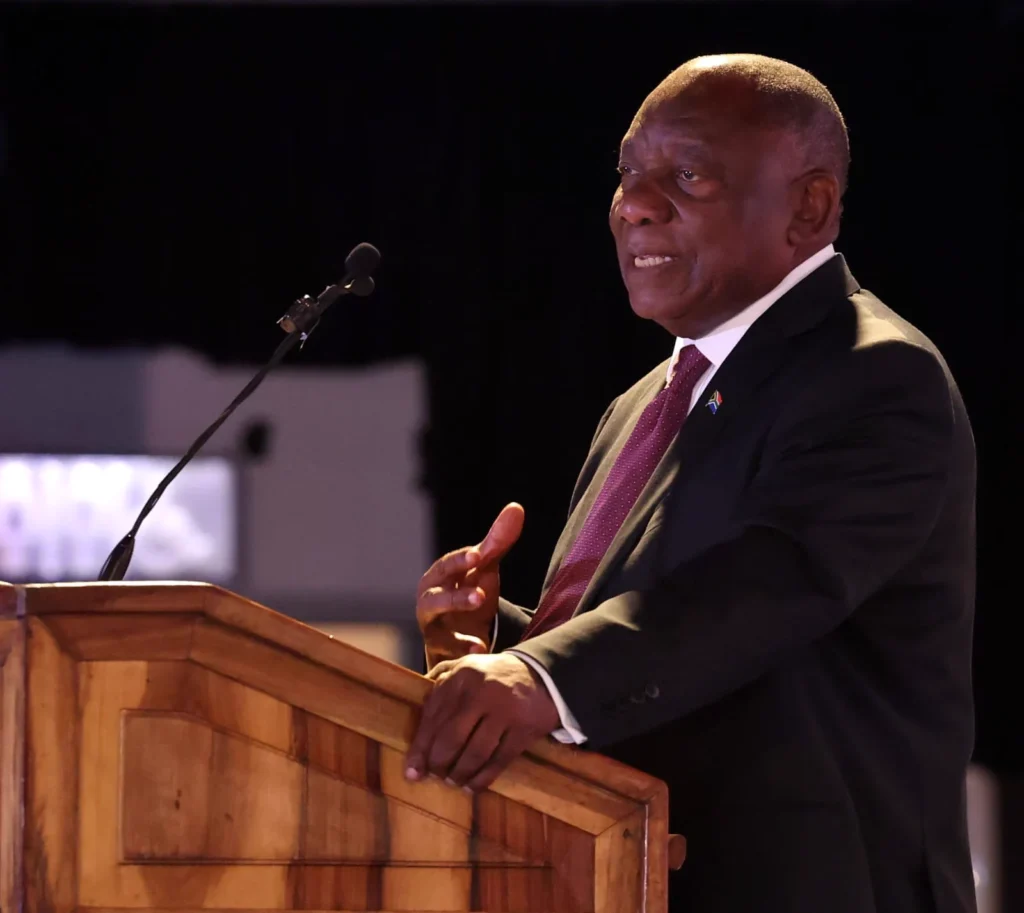
On Thursday, 22 October, at a hotel in Ekurhuleni with a theme and a lanyard, President Cyril Ramaphosa unveiled the “far-reaching reform” of local government.
Thirteen days before South Africans vote in the local elections, the patient was presented with a White Paper, a Transition Management Body, and a promise that this time, truly, every municipality must work.
I read the whole speech twice. Somewhere around the second reading, I started looking for the part where somebody gets fired.
I am still looking.
The State Discovers Its Own Failure
The President told us that “when mandates overlap, when investment is poorly coordinated or when support arrives only after a crisis, the entire system has failed the community.”
That is a remarkable sentence, because it is an indictment of the government delivering it. Who coordinated the investment? Who ran the overlapping mandates? Who arrived late, after the crisis, with a media statement and a task team?
National and provincial governments were not bystanders to the municipal collapse. They were in the room, holding the clipboards. Now they return with a new set of clipboards.
Differentiation Is A Polite Word For Demotion
The centrepiece is a “differentiated model”: powers and functions pegged to a municipality’s “size, capability and performance.” Strip away the consultancy vocabulary and the proposal is this: where the state has failed to build capacity, it will remove the responsibility.
Think about who that describes. Not Sandton. Not the wealthy suburbs with private security, boreholes and solar arrays. It describes the rural municipality with a thin revenue base, a hollowed-out engineering department and a council that cannot recruit a qualified water technician because the last one was displaced by somebody’s cousin. The municipality that has been starved is told it is too weak to be trusted, and the function is lifted away.
Lifted to where? To “other spheres of government”, to “regional level”, to “partnerships and concession arrangements.” In other words, to provincial administrations that cannot run their own hospitals, or to private operators who will, naturally, require a return on the water they sell to the poor.
Residents lose the one official they could still shout at in person. A councillor can be voted out. A concession holder has a contract.
The same paper speaks of a “pathway to a single-tier future.” Say it plainly and see how it sounds: the architecture of local democracy is being redesigned by the very government that let it rot, and the people most affected are being asked to comment by a deadline.
The Constitution As An Obstacle
Then comes the part that should make every citizen sit up. The President says the model “calls for constitutional and legislative amendments to be considered where necessary.”
Consider the ambition. A government that cannot keep a sewage plant from discharging into a river proposes to reopen the supreme law of the land. The Constitution did not fail Emfuleni. The Constitution did not leave Bronkhorstspruit to drink what came out of the tap. Section 139 already allows provincial intervention in a failing municipality. The power exists. It has existed for decades. What has been missing is the will, the competence, and the spine to use it early and well.
Amending the Constitution to compensate for a shortage of nerve is like demolishing the house because nobody will fix the geyser.
Ring-Fencing, Or: The Thing You Were Meant To Be Doing
“Revenues from the sale of electricity and water will be ring-fenced and used to maintain infrastructure before anything else.” The room applauded, I assume. I would ask the obvious question: what, until now, were these revenues for?
Municipalities owe Eskom more than R120 billion. Many are in arrears to the water boards. The money collected for water has been spent on everything except water, and the President has announced, as innovation, that water money will now be spent on water.
Maintenance, we are told, will become “a planned, funded and monitored obligation.” I am delighted. I would simply note that it was always an obligation. It was the monitoring that was missing, and monitoring requires someone willing to say no to a mayor, a municipal manager or a connected tender-holder.
The minister himself conceded that cadre deployment has “severely compromised” municipal performance. Splendid. A confession is progress. But a confession followed by a policy that does not name a single deployed official, a single captured department or a single consequence is not reform. It is a public statement with a conscience.
The Body That Decides But Does Not Govern
Then there is the Local Government Transition Management Body, to be led jointly by CoGTA, the Presidency, and National Treasury. It will ensure that “difficult decisions are taken”. Yet it “will not take over the lawful responsibilities of Ministers, provincial governments, municipal councils, or municipal administrations.”
A body that decides but cannot act. Marvellous. A new body, with no authority over anyone, will make sure that difficult decisions are made by the people who have spent decades avoiding them. I have seen better accountability structures in a WhatsApp group planning a braai.
And it is “time-bound,” which in South African policy usually means the time will run out before the bound does.
The Calendar Is The Tell
The White Paper was launched on 22 October, in the final fortnight of an election campaign. The President asked the public to treat reform as “a national undertaking that must outlast any election cycle.”
Fine words, delivered, curiously, inside an election cycle.
He also warned that “a disagreement in council must never become an excuse for an unapproved budget, an abandoned project or the collapse of an essential service.” Excellent advice for coalition councils, though it might have carried more weight if his own party had not spent years treating municipalities as employment agencies for the loyal.
What The People Are Owed
I do not doubt that the diagnosis is accurate. More than 90% of households have electricity, and 87% have piped water, and the President was right to say those gains sit beside rot.
Before anybody redesigns the structure of local government, before anyone touches the Constitution or hands a water works to a concessionaire, South Africans are owed three things:
The names of the municipal managers who presided over the collapse and what happened to them.
A timetable for early intervention that is enforceable, with consequences for the officials who fail to act on it.
A guarantee, in writing, that no community will lose its democratic voice over a service it cannot afford to be disconnected from.
Until then, “Every Municipality Must Work” remains a slogan on a banner, hung in a government office over the heads of people who have not figured out which way the sun rises.
I will believe in reform when somebody, anybody, is held accountable for the collapse.
Get the morning briefing
Our editors’ choice of the day’s stories, in your inbox at six.



Comments
No comments yet.