By Themba Khumalo
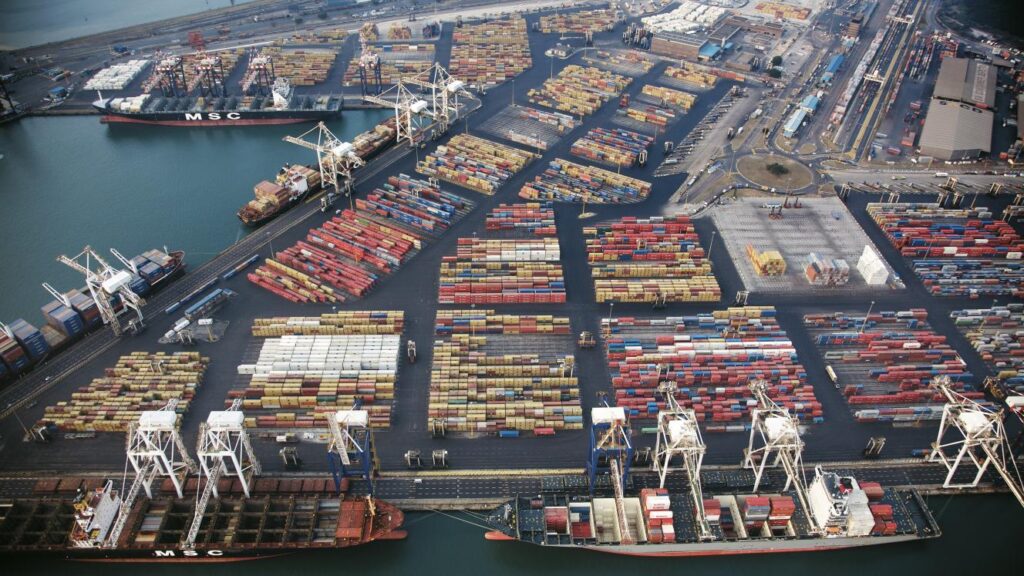
South African manufacturers are expected to compete in the global economy, honour their contracts and keep production moving. Yet the institution entrusted with keeping the country’s trade moving cannot get cargo off ships and into factories.
The insult is compounded by the fact that businesses are left carrying the financial consequences of a failure they did not create.
Businesses are being asked to manufacture, employ people, meet deadlines and keep the economy alive, yet Transnet has turned the movement of goods into an endurance test that would exhaust even the most patient businessman.
A report by Freight News, published on 28 October 2026 under the headline Port bottlenecks deal blow to manufacturers, lays bare the extent of the disruption at Durban Gateway Terminal and the mounting costs being inflicted on South African businesses.
Its reporting paints a deeply troubling picture of a logistics system in which manufacturers are losing production time, customers are becoming impatient, and companies are being forced to spend more money simply to get the components they need to keep operating.
This is not some minor administrative inconvenience or an unfortunate interruption in an otherwise smoothly functioning operation. It is an assault on the productive capacity of an already struggling economy, with manufacturers left counting their losses while ships sit outside the harbour, containers remain beyond reach and production schedules disintegrate.
The consequences are being felt far beyond the port gates, in factories, warehouses, boardrooms and the pockets of businesses that have done nothing wrong except depend on Transnet to perform a basic function.
Consider Zoeller Waste Trucks in Sebenza, Edenvale. According to Freight News, the company was forced to halt production after six containers carrying components from Germany and Poland remained aboard two vessels anchored outside Durban for more than a month, according to managing director John Bowman.
Six containers. Not six hundred, not an entire fleet of ships, but six containers carrying the components needed to keep a manufacturing operation alive.
The company assembles refuse trucks using imported flat-pack kits, and its production process depends on those components arriving when they are supposed to. The operation has seven stages, but when the first stage cannot begin, the other six might as well be staring at an empty factory floor. That is precisely what happened. Work stopped because the components were not available.
Bowman described it as the worst disruption the company had experienced. One vessel’s cargo might even have to be diverted to the Port of Port Elizabeth before being transported by road to Gauteng, although that arrangement had not been confirmed. Imagine the absurdity of importing components through a major commercial port, only to contemplate sending them to another port and then hauling them back towards the industrial heartland because the original gateway cannot get the job done.
This is what Transnet’s operational failures look like when they escape the comfort of corporate presentations and land on the factory floor. They are not abstract performance indicators or numbers in a quarterly report. They are idle machinery, frustrated workers, interrupted production, missed deadlines and customers who begin wondering whether the supplier they trusted can still deliver.
And Zoeller is not alone. Freight News reports that a supplier whose business serves manufacturers in the food and beverage, energy and transport industries has also been caught in the port congestion crisis. With sea freight taking too long, the company has resorted to air freight, accepting lower margins to ensure that customers receive their goods. It must also contend with the expense of sourcing local substitutes, some of which fail to satisfy the technical requirements of the imported products.
What kind of logistics environment forces businesses to abandon the cheaper, established method of transporting goods and pay through the nose to fly components into the country because ships cannot be unloaded in reasonable time?
Air freight is supposed to be an option for urgent consignments, not an increasingly expensive escape route from a dysfunctional port operation.
Yet this is the position into which South African manufacturers are being pushed. Their margins are squeezed from one side by rising operating costs and from the other by a logistics system that adds expense, uncertainty and delays to the ordinary business of manufacturing. They are expected to absorb the consequences of failures over which they have no control, while their customers become increasingly impatient and their competitors elsewhere operate in markets where moving cargo is not an adventure.
The damage does not end with the businesses directly importing goods. It travels through the entire supply chain, spreading its tentacles into transport companies, depots, suppliers, contractors and customers. When a factory cannot obtain components, production suffers. When production suffers, delivery commitments are threatened. When delivery commitments are threatened, contracts become vulnerable. When companies start losing business because they cannot guarantee delivery, the damage reaches employment and investment.
Transnet should understand this better than anyone. Its ports and railways are not ornamental national assets whose existence can be celebrated while their users struggle to extract any meaningful value from them. They are essential arteries of the economy. When those arteries become clogged, the consequences are felt throughout the economic body.
The information gathered by Freight News from industry representatives paints a particularly uncomfortable picture of the Durban operation. Dave Watts, maritime consultant to the South African Freight and Logistics Association, has raised concerns about the difficulty of obtaining reliable operational figures, from the time trucks spend at the terminal to cargo volumes handled on the waterside and the average period vessels remain waiting outside the port.
There is even a discrepancy between the terminal’s reported 11 vessels at anchorage and the eight reported by marine operations, apparently because the terminal includes vessels inside the port but not alongside in its count of vessels at anchorage.
Even the basic business of establishing what is happening at the port appears unnecessarily complicated. When those who depend on a terminal cannot obtain consistent information about its performance, what exactly are they supposed to plan around? Manufacturing cannot operate on guesswork. Shipping schedules cannot be managed through wishful thinking. Businesses need reliable information because their own operations depend on it.
Watts also pointed to reported gate movements of approximately 2,219, below a previous key performance indicator of more than 3,000. There may be several explanations for the reduced activity, including equipment shortages or an operational focus on waterside activity, but the uncertainty itself illustrates the problem.
Industry needs dependable figures to assess whether the terminal is recovering or simply rearranging its difficulties.
Meanwhile, transporters are still grappling with limited truck slots, lengthy depot waits and rising labour and standing costs. Aven Naidu, chairman of PFS Container Division, told Freight News that although there had been some progress in clearing import containers from the yard, the landside operation remained under pressure. Data released by the terminal for the first half of October showed that daily performance targets were repeatedly missed, while roughly a quarter of trucks spent more than two hours waiting to enter the yard.
One in four trucks waiting more than two hours. Those are hours that drivers cannot recover, vehicles that cannot be deployed elsewhere and businesses that continue paying for time wasted outside a terminal. The costs accumulate, but Transnet does not appear to be the one carrying the heaviest burden.
And when the obvious solution becomes diverting cargo to another port, the financial madness deepens. Naidu pointed out that sending cargo through Port Elizabeth would mean transporting it more than 1,000 kilometres by road to Gauteng, adding further costs and time. In other words, businesses must pay extra to compensate for the failure of the gateway through which their goods were supposed to arrive.
The figures from the South African Association of Freight Forwarders make the situation even more troubling. Its statistical update of 22 October 2026 reflected some improvement in yard conditions, with stack occupancy easing to 55.3%, but waterside pressure persisted, with between 10 and 12 vessels at anchorage, according to Jacob van Rensberg, the association’s head of research and industry intelligence.
SAAFF’s 2026 assessment puts throughput at approximately 3,300 moves a day, against a target of 3,400, with incoming vessel demand absorbing most of that capacity and leaving little room to attack the existing backlog.
The association’s modelling indicates that affected supply chains are carrying approximately 18 additional days of delay. Even if the terminal managed to sustain 4,600 moves a day, it would still take about a month to clear the existing queue.
A month. That is what recovery looks like when a port has accumulated a backlog that has become an economic burden of its own. While Transnet and its terminal operators work through their operational difficulties, manufacturers are expected to keep their businesses alive, reassure customers and find ways to pay for delays that should never have become normalised.
Then comes the familiar corporate language of recovery, investment and long-term transformation.
Javier Lancha, chief executive of Durban Gateway Terminal, acknowledged to Freight News that the transition to the Navis N4 operating system initially presented operational challenges for stakeholders. He said the platform had since stabilised and that an operational recovery programme was being prioritised to improve cargo flow, reduce congestion and strengthen customer service.
There is also a commitment by the terminal to invest more than R2 billion over the next three years. Lancha said the programme would include the purchase of new and second-hand original equipment manufacturer-certified straddle carriers, alongside a move towards hybrid rubber-tyred gantry operations, beginning with 16 hybrid RTGs.
Fine. Equipment must be replaced, infrastructure upgraded and technology improved. Nobody disputes the need for investment in a port that must serve a modern economy. However, South African businesses have heard enough about plans, programmes, platforms and promised improvements to be entitled to ask a rather uncomfortable question: how many more production lines must stop before these investments translate into an operation that works?
There is another question Lancha’s response leaves hanging. Although he described operational recovery as an immediate priority, he did not provide the requested details about the equipment currently operational at the terminal. That information is not some obscure technical curiosity. It goes directly to the heart of the problem. Businesses need to know whether the terminal has the equipment, capacity and operational discipline to handle the cargo coming through its gates.
A promise to spend R2 billion over three years does not retrieve the six containers holding up Zoeller’s production line today. A new operating system does not compensate a manufacturer for a month of vessel delays. Sixteen hybrid gantry cranes, however welcome, do not magically restore the contracts and confidence lost while businesses wait for imported components.
There is a difference between announcing a recovery and delivering one. Transnet, its terminal operators and the people entrusted with managing these strategic assets must understand that the distinction is measured in real money and real livelihoods.
South Africa cannot afford to treat its logistics crisis as an internal corporate inconvenience, as though the greatest consequence of poor port performance is an uncomfortable meeting between executives and frustrated industry representatives. The cost is being transferred to businesses that must pay workers, maintain machinery, service customers and compete in an economy already burdened by high costs and weak growth.
Manufacturers cannot manufacture promises. Truck operators cannot transport explanations. Exporters cannot ship corporate presentations. And businesses cannot pay their creditors with assurances that operational recovery is somewhere in the pipeline.
Transnet must stop expecting the country to applaud investment announcements while the machinery of commerce continues to grind against its failures. Its responsibility is not to produce impressive recovery plans or offer soothing explanations about new systems and equipment. Its responsibility is to keep the country’s goods moving, its ports functioning and its economy connected to the markets on which its survival depends.
The manufacturers of this country are not asking for miracles. They are asking for a functioning port, reliable schedules and the basic competence required to move cargo from a ship to a factory without turning the journey into a financial punishment.
That should not be an extraordinary demand in a country that depends on trade to create jobs, sustain industries and grow its economy.
It should be the bare minimum. And Transnet should be thoroughly embarrassed that even that has become too much to ask.
Get the morning briefing
Our editors’ choice of the day’s stories, in your inbox at six.




Comments
No comments yet.