By Themba Khumalo
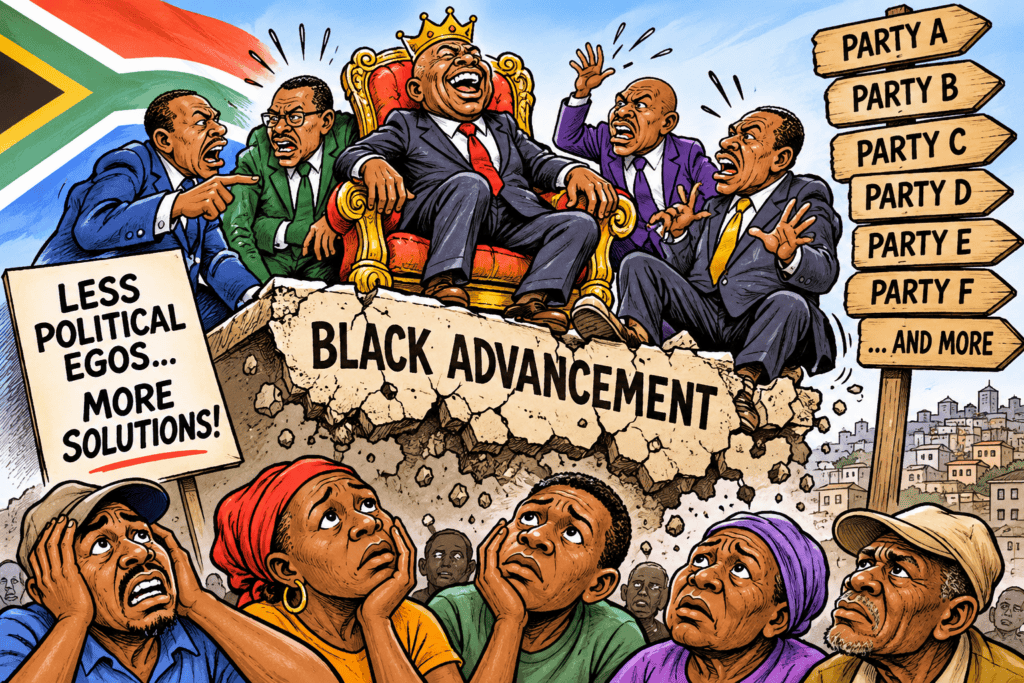
South Africa does not have a shortage of black political parties. It has a shortage of black political maturity.
We have political parties sprouting like weeds after the first summer rains, each with its own president, its own manifesto, its own collection of political casualties and, apparently, its own exclusive interpretation of what liberation means.
Everybody wants to lead. Everybody wants to be the face of change. Everybody wants to inherit the people’s suffering and turn it into political capital. Yet, when the moment arrives to put their egos aside and build something bigger than themselves, they scatter like frightened chickens.
This is the great betrayal of black politics in democratic South Africa. The very people who claim to champion the interests of the black majority cannot find enough common ground to stand together. They can agree on the existence of poverty, unemployment, landlessness, economic exclusion and the indignity of black life.
They can deliver fiery speeches about historical dispossession and the unfinished business of liberation. They can fill stadiums with promises and make the most magnificent noises about economic emancipation.
But ask them to unite behind a common political purpose and suddenly everybody develops a different interpretation of the revolution.
What exactly are they fighting for?
If the declared objective is to improve the material conditions of black people, what is so ideologically complicated about working together? If they all want jobs, decent housing, functioning municipalities, access to land, economic opportunity, better education and an end to the structural inequalities inherited from apartheid, why must they pursue these objectives from a dozen different political trenches?
Are the lives of black people so different that they require an endless collection of political parties to represent the same fundamental aspirations?
Or is the real problem that the people who lead these parties have mistaken their personal political ambitions for the aspirations of an entire people?
Let us dispense with the diplomatic language. Black political fragmentation is not a harmless expression of multiparty democracy. It has become a political disability. It has weakened the collective bargaining power of the black majority and made it increasingly difficult for that majority to translate its numerical strength into political power directed at changing its material circumstances.
Call it multiparty democracy if you wish. Dress it up in the respectable language of political pluralism. Celebrate the right of every individual to establish a political organisation. But when the ballots are counted, the arithmetic is merciless. A divided majority is a politically diminished majority.
And that is precisely what is happening.
The contrast with white political organisation is difficult to ignore. White political support is largely concentrated around two principal political formations. There are differences between them, fierce disagreements and competing political philosophies. Yet their political constituencies are not scattered across an absurd number of competing organisations, each fighting for a piece of the same electoral pie.
Black political support, by contrast, has become a sprawling political marketplace. Everybody is selling the same merchandise under a different label. The packaging changes. The slogans change. The faces change. The promises are repackaged and sold to an electorate that has heard them all before.
The consequence is that the black majority, despite its numerical strength, repeatedly finds itself negotiating from a position of weakness.
This is not an indictment of the right to political choice. It is an indictment of the failure to distinguish political choice from political self-sabotage.
There is nothing inherently wrong with political differences. Democracies need disagreement. They need competing ideas, alternative policies and robust political debate. But disagreement without a larger purpose becomes an exercise in collective paralysis. Political competition is supposed to produce better leadership and better government. It should not become an elaborate mechanism through which political leaders destroy the possibility of achieving anything together.
The uncomfortable truth is that much of this fragmentation is not even ideological.
It is personal.
Everybody wants to be president. Everybody wants the microphone, the motorcade, the security detail, the parliamentary platform and the authority that comes with being the head of an organisation. Nobody wants to be second in command. Nobody wants to subordinate personal ambition to a collective undertaking. Nobody wants to disappear into a larger political project where the credit for success might have to be shared.
The presidency of a political party has become more attractive than the responsibility of changing the lives of the people such a party claims to represent.
We have created a political culture in which every disgruntled politician believes the solution to a leadership disagreement is to establish another party. A disagreement becomes a divorce. A failed leadership contest becomes a new political movement. A bruised ego becomes a founding conference. Before long, another political organisation emerges, complete with a new constitution, a new logo and another promise to rescue the black majority.
Rescue it from whom?
Sometimes, judging by the conduct of these political leaders, the black electorate needs rescuing from the very people who claim to be its political liberators.
Our politics has become a collection of competing political chieftaincies. Each leader wants to command his own kraal, dispense patronage, appoint loyalists and preside over his own little empire. The party becomes an extension of the leader’s personality rather than an instrument for implementing a shared vision.
The tragedy is that the electorate is expected to keep financing this vanity through its votes.
There is a bigger historical wound here.
Black unity has been discussed for generations. It has been invoked in speeches, conferences, declarations and political manifestos. It has been elevated to the status of a sacred political ideal. Yet, when the practical demands of unity arrive, the same old divisions return. Historical disagreements become permanent political hostilities. Differences in political strategy become excuses for lifelong separation. Former comrades become sworn enemies, and the liberation movement’s language of solidarity is reduced to a collection of competing political slogans.
We have become extraordinarily good at commemorating the struggles of those who came before us and remarkably poor at completing the work they left behind.
What was the point of fighting for political emancipation if the political freedom secured through that struggle would eventually become a playground for competing egos?
What was the point of demanding that the black majority control its political destiny if its political representatives cannot even agree on a common direction?
And what exactly does liberation mean to a black person whose children remain unemployed, whose community has no reliable water, whose local clinic is collapsing and whose municipality cannot deliver basic services?
The liberation struggle was never supposed to produce an endless collection of political presidents. It was supposed to change the conditions under which ordinary people lived.
That distinction appears to have escaped a considerable section of our political leadership.
The governing record of the black political establishment has made this failure even more damaging. Decades of political power have not translated into the broad-based material transformation that millions of black South Africans were promised. The geography of poverty remains painfully familiar. Economic exclusion continues to define the lives of entire communities. Unemployment has become a permanent feature of family life. Municipal collapse has turned basic services into privileges.
The black majority has been asked to be patient while political leaders argue about succession, positions, factions and control.
How much patience must a people have?
How many generations must wait for the fruits of a freedom that was supposed to belong to them?
The governing establishment cannot escape responsibility for the political disillusionment that has followed. Its failures have created fertile ground for political breakaways, splinter movements and alternative formations. But the emergence of more political parties has not necessarily produced a stronger black political constituency. In many instances, it has produced the opposite: a fragmented electorate and a political class incapable of converting collective grievances into collective power.
This is where the argument becomes particularly uncomfortable for black political leaders.
They have spent years blaming historical injustice, entrenched economic power and the enduring consequences of apartheid. Much of that criticism is justified. But they must also confront the damage caused by their own conduct. It is no longer sufficient to blame the historical enemy for every contemporary failure while refusing to examine the political dysfunction taking place within their own ranks.
White political and economic interests do not need to do all the work of keeping the black majority politically divided when black political leaders are perfectly capable of doing it themselves.
And that is the real political tragedy.
A politically fragmented majority is easier to negotiate around, easier to outmanoeuvre and easier to disregard. Its numerical strength becomes an impressive statistic without equivalent political consequence. Its grievances become campaign material. Its aspirations become bargaining chips. Its votes become currency in negotiations from which ordinary people frequently receive very little.
There are also questions that black political leaders should be asked about the political funding environment. Who benefits when the black vote is scattered across an assortment of competing organisations? Who benefits when no coherent political bloc can exercise sustained pressure for meaningful economic transformation? Who benefits when black political leaders spend more time fighting one another than challenging the structures that continue to reproduce inequality?
These are legitimate questions. They deserve answers, not accusations of political heresy.
South Africa is a country of immense resources and economic potential. Its black majority should not have to accept political helplessness as the natural condition of democracy. There is no shortage of capable people, political ideas or policy proposals. What is missing is the political discipline to bring competing interests together around a common national and material purpose.
And this is where the coming coalition negotiations will expose the true character of black political leadership.
Will the discussions be about the conditions of ordinary people, or will they become another auction of political positions?
Will leaders negotiate around a common programme to repair collapsing municipalities, improve public transport, restore reliable electricity and water services, create economic opportunities and address the crisis of urban decay?
Or will they arrive with shopping lists of executive positions, committee chairmanships, mayoral offices and control of municipal departments?
Will they ask what they can collectively accomplish, or what each of them can personally extract?
The distinction is not academic. It is the difference between a political coalition and a political feeding arrangement.
A coalition built around personalities and positions is already living on borrowed time. It will collapse at the first serious disagreement over power. Its members will discover that the people who were supposed to be partners are actually competitors temporarily sharing a political roof.
And when that happens, the black electorate will once again be left holding the bill.
The greatest irony is that those who claim to be fighting for black advancement may end up handing political opportunity to formations whose historical and ideological traditions are entirely different from their own. Not necessarily because those formations have discovered some extraordinary secret to governance, but because political discipline, organisation and the ability to work together are advantages that cannot be manufactured overnight.
One cannot spend years celebrating the numerical superiority of the black majority and then act surprised when that majority fails to exercise corresponding political power.
Numbers without organisation are just numbers.
Votes without a common purpose are easily dispersed.
And political parties without the courage to subordinate personal ambition to a greater undertaking are little more than private political enterprises trading in public frustration.
Black political leaders need to confront a question that their manifestos have conveniently avoided: What is the point of having so many political parties if their combined political existence cannot produce a coherent programme for changing the lives of the people they claim to represent?
The answer is as painful as it is obvious.
We have too many political leaders who want to make history and too few who are prepared to do the unglamorous work of changing it.
The black majority did not struggle for the right to choose between an endless collection of political egos. It struggled for dignity, economic freedom, opportunity and control over its destiny.
Instead, it has been presented with a political marketplace in which everybody wants to sell it liberation, but nobody seems willing to deliver the goods.
This is not multiparty democracy at its finest. It is political fragmentation at the expense of a people.
And while the political chieftains quarrel over who must sit at the head of the table, somebody else will happily occupy the table, take the decisions and exercise the power that the black majority has repeatedly failed to organise itself to wield.
The most devastating defeat of black politics will not come from losing an election to another political formation.
It will come from having the numbers to change the country, the opportunity to do so, and the collective political stupidity to squander both.
A divided majority is not a majority in any meaningful exercise of power. It is a captive audience for the ambitions of its own political leadership.
Get the morning briefing
Our editors’ choice of the day’s stories, in your inbox at six.




Comments
No comments yet.