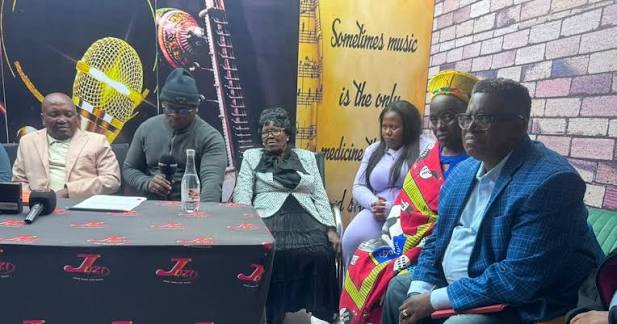
The crisis engulfing Jozi FM is greater than a quarrel between competing factions. It raises serious questions about accountability, public trust, and the stewardship of community institutions. With millions in disputed lottery funding and governance in paralysis, Soweto’s greatest megaphone faces an uncertain future.
By Themba Khumalo
The public breakdown of governance at Jozi FM and its operating body, the Soweto Media Resource Centre (SMRC), has ceased to be a simple administrative disagreement.
It has degenerated into an act of institutional self-sabotage that threatens to destroy Gauteng’s premier community broadcasting platform.
What was established by and for the people of Soweto to give an authentic voice to the township’s working-class households has descended into a bitter arena of parallel chief executives, disputed chairpersons, criminal counter-allegations and private security guards physically barring access to the station’s premises in Dube.
This operational paralysis comes at a tragic juncture. Jozi FM is not a failing enterprise on the airwaves; it is an undisputed commercial and cultural powerhouse. Yet, if the warring factions continue to treat the station as a collection of personal fiefdoms, this vital public asset will inevitably become a tragic cautionary tale.
A Proud Legacy Born in the Heart of Soweto
To understand what is at stake in Dube, one must remember how Jozi FM was founded. The station was created explicitly to serve the residents of Soweto, tracing its roots back to 1995 with the launch of Soweto Community Radio.
Operating under difficult conditions, with limited equipment and uncertain backing, the station fought to give Sowetans an independent platform on the airwaves. Between 1999 and 2000, a strategic merger between Soweto Community Radio and Buwa Radio gave birth to Jozi FM, consolidating its mandate as the definitive voice of the township.
While the strength of its signal naturally spills across broader municipal borders into neighbouring areas, the station’s ethos, identity and editorial mandate remain rooted in Soweto. Broadcasting in isiZulu, isiXhosa, Sesotho, English, Sepedi, Setswana and Xitsonga, the station established an intimate relationship with its primary listenership.
It serves as a crucial incubator for local South African broadcasting talent, nurturing prominent media personalities who would later fill the ranks of national public and commercial networks.
More importantly, Jozi FM became Soweto’s primary community node, blending news, municipal accountability, public service announcements and local culture. It grew from a modest township experiment into the first community station hosted on national satellite audio bouquets, setting the benchmark for community media across the continent.
The Numbers Behind a Township Heavyweight
The tragedy of the current crisis is that it strikes an institution operating at the peak of its audience reach. Official listenership figures from the Broadcast Research Council of South Africa (BRC RAMS) consistently place Jozi FM at the absolute top of community radio in Gauteng.
- 395 000 to more than 500 000 weekly listeners: BRC RAMS audience tracking routinely places Jozi FM as the most-listened-to community radio station in Gauteng, frequently outperforming major commercial regional competitors across key township demographics.
- Dedicated local footprint: Anchored directly in Soweto, the station commands massive loyalty among township households that view it as their primary and trusted source of daily news and local representation.
- 50/50 programming split: By strictly balancing talk, news and community discussion with local music, the station has built an exceptionally loyal audience that relies on its platform for daily civic information.
To command the loyalty of half a million listeners in South Africa’s most competitive media market is a massive operational success.
Commercial advertisers, corporate brands and municipal departments spend millions of Rands with Jozi FM precisely because it offers unmatched access to the Soweto consumer base. However, corporate capital is inherently risk-averse. Advertisers will not continue to inject marketing funds into an institution where board legitimacy is contested daily, where access to bank accounts requires urgent court intervention, and where physical access to the studios is regulated by private security firms.
The Shadow of R34.8 Million in Missing Lottery Grants
Underpinning the governance breakdown is a deep financial dispute that has drawn the attention of law enforcement agencies. The Special Investigating Unit (SIU) is investigating more than R34.8 million in National Lotteries Commission (NLC) grants disbursed to the Soweto Media Resource Centre.
Official NLC records confirm that millions were transferred to the SMRC across multiple tranches between August 2013 and October 2015:
- August 2013: Initial tranche of R12 million disbursed under NLC project number 72744.
- April 2014: Second tranche of R12 million disbursed for the same project.
- October 2015: Third tranche of R10.8 million disbursed, bringing the total allocation for the project to R34.8 million.
- 2016: An additional grant of R407 400 was approved for a heritage songbook project, although secondary tranches were withheld when the entity failed to submit progress reports.
According to grant documentation, these funds were allocated for the construction of a state-of-the-art multimedia centre and museum in Soweto, alongside a historical documentary project titled Freedom Was Not Free. Yet station management, led by CEO Mpho Mhlongo, publicly revealed that the multimedia centre was never constructed, prompting them to lodge formal criminal complaints of fraud and corruption with the Orlando Police and the SIU.
The fallout was immediate. Board chairperson Rapitse Montsho was arrested in November 2025 on charges of fraud and theft relating to the missing funds. While those charges were provisionally withdrawn in March 2026 to allow the matter to be escalated to the Specialised Commercial Crimes Unit, the broader SIU probe remains active.
The investigation continues to hang over the organisation, triggering board resignations and destroying trust between executive management and non-executive directors.
Dual Executive Claims and Regulatory Directives
The dispute over financial accountability has triggered a complete breakdown in administrative control. Today, Jozi FM is effectively trapped between two opposing factions claiming legal authority over the station:
- Parallel boards and CEO standoff: Montsho’s faction appointed Collen Hans as acting CEO and announced the suspension of Mhlongo. In response, Mhlongo rejected his suspension, maintained the support of station staff and aligned himself with nine newly elected SMRC directors.
- Physical lockouts at Dube: The administrative warfare spilt into the physical realm when private security guards were deployed at the station’s Dube headquarters, blocking Hans from entering the building as Mhlongo resumed his duties.
- Court battles over bank accounts: The SMRC launched urgent High Court applications seeking to gain control of primary operational bank accounts allegedly controlled by Montsho. While the courts struck down the urgency of the application and directed the organisation to hold an Annual General Meeting (AGM) within 60 days, compliance remains bogged down in legal challenges.
- ICASA directives ignored: The Independent Communications Authority of South Africa (ICASA) stepped in to reject the unprocedural removal of board members and instructed the entity to convene a proper AGM. However, legal representatives for the Mhlongo-aligned faction publicly dismissed the regulator’s stance, citing prohibitive costs and signalling their intent to challenge judicial rulings.

The Cost of Chaos: On-Air Fallout and the Path Forward
An institution cannot survive when its leaders spend their energy issuing conflicting media notices, opening criminal dockets against one another and arguing over corporate bank accounts.
The internal rot has already begun to affect operational stability. The recent termination of several on-air presenters and technical staff — amid claims of service breaches and code-of-conduct violations — demonstrates an organisation that is losing its operational balance.
When leadership loses sight of its public mandate, quality programming suffers, staff morale drops and listeners slowly tune out. The commercial sector will not wait for Jozi FM to fix its internal problems. As advertisers redirect their budgets to safer, more stable commercial alternatives, the station risks running into severe cash-flow shortages.
The warring factions within the Soweto Media Resource Centre must recognise that they are custodians, not owners, of a public trust.
The only way forward requires an immediate end to parallel administrative structures, unconditional respect for statutory bodies such as ICASA, and strict adherence to High Court directives to hold an open and transparent Annual General Meeting.
Jozi FM was built by and for the people of Soweto to serve as a beacon of local community empowerment. If those claiming to lead it continue to prioritise personal survival over institutional integrity, they will succeed only in silencing the most powerful voice in township broadcasting — turning a remarkable success story into an empty studio and a tragic cautionary tale.
Get the morning briefing
Our editors’ choice of the day’s stories, in your inbox at six.



Comments
No comments yet.