By Themba Khumalo
By the time the sun rose over Reiger Park on Saturday, 8 August, four families were waking to a reality that no family should ever have to learn to accept: people who had left home the previous evening, Friday, 7 August, expecting to return had not come back, after a night of gunfire turned an ordinary evening into another encounter with the lethal violence that has become all too familiar in parts of South Africa.
Constables Thapelo Tlomatsane and Sphiwe Sibeko, two young police officers who had barely two years of service behind them and were attached to the Anti-Gang Unit, had been responding to reports of gunfire when they were ambushed. Roleen Lessing, 36, and Jaydin Magerman, 27, were shot through the windscreen of their vehicle as they made their way to a shop, on an evening when the two cousins had planned to celebrate Jaydin’s birthday.
The details matter because they strip away the abstraction with which South Africa has become accustomed to discussing violent crime.
Behind every reference to “gang violence”, “illegal firearms”, “high-crime areas” and “policing challenges” are people whose lives do not resume when the news cycle moves on: families whose ordinary routines have been permanently broken, celebrations that will never happen, and loved ones who must now learn to live with an absence created in seconds by somebody else’s decision to pull a trigger.
And then, as piss follows beer, the following day the Minister came.
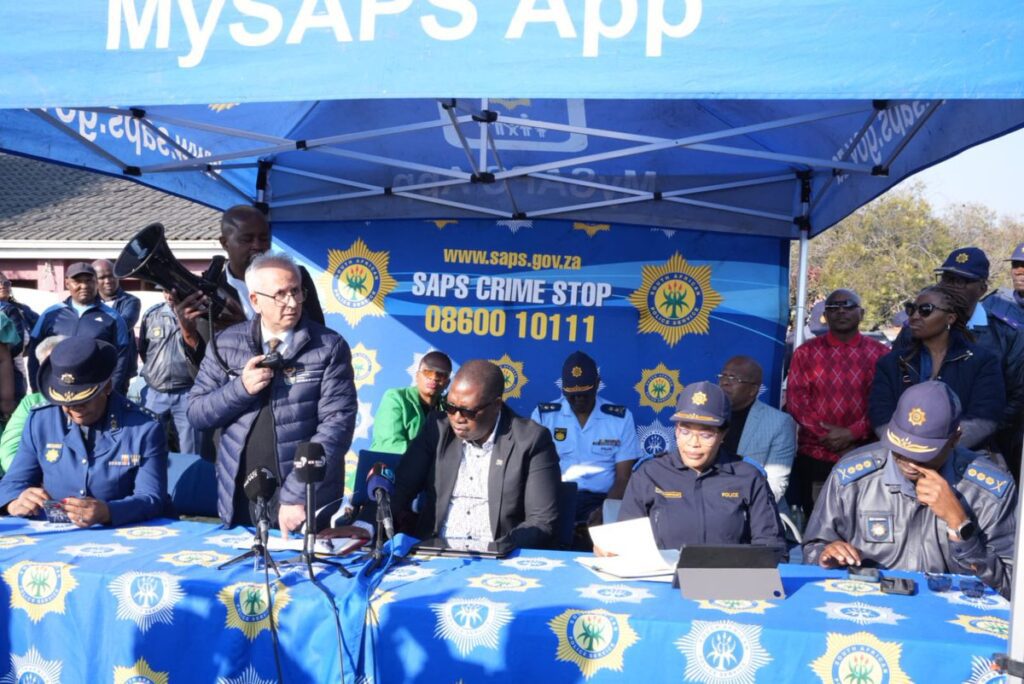
Acting Police Minister Firoz Cachalia visited Reiger Park, described the killings as merciless, temporarily deployed the army, and spoke of the need to “reclaim our streets” and “reclaim our communities”, adding that “the community has to stand up”.
Government’s own statement went further, saying that communities have “a vital role to play in reclaiming their neighbourhoods” because the fight against crime “cannot be won by law enforcement alone”.
The sentiment is difficult to dispute. Communities do have a role to play, and those who live in a neighbourhood often know its criminal networks, its vulnerable points and its changing patterns of violence that no police database can fully capture.
Neighbourhood watches, community policing forums and residents prepared to share information can make an important contribution to preventing crime and helping investigators understand what is happening on the ground.
Numerous organisations, among them Safe Citizen, have been making this argument precisely for years: communities cannot be passive spectators in the fight against crime, but neither can they be quietly transformed into an auxiliary police force and then left to carry a responsibility for which they have neither the training nor the legal authority to fulfil.
Most people in Reiger Park cannot afford private security companies. What they have is each other: neighbours who keep watch, community policing structures, residents who exchange information and ordinary licensed firearm owners who, within the limits of the law, have accepted the responsibility that comes with owning a firearm for lawful self-defence.
That is the capacity the Minister is asking communities to mobilise.
So the question is a simple one, although the answer is anything but: Stand up with what, Minister?
Residents can report suspicious activity. They can keep neighbourhood watches functioning. They can share information with investigators and maintain the civic structures that help communities resist criminality.
They can refuse to psychologically surrender their streets to people whose livelihoods depend on fear. What they cannot reasonably be expected to do is become the frontline in a fight against armed criminals when the state itself recognises the severity of the problem and has found it necessary to deploy the military.
There is a fundamental distinction between asking citizens to participate in making their communities safer and asking them to assume responsibility for defeating criminals whom the state, with all its powers, resources and institutions, has struggled to contain.
The first is citizenship.
The second is an abdication of responsibility dressed up as community empowerment.
And even within the narrower responsibility of protecting one’s own home and family, the ordinary citizen is entitled to ask what practical capacity remains available when the police are minutes away, the criminal is already at the door and the law has been designed around an assumption of protection that, in too many communities, does not correspond with lived reality.
This is why the Minister’s words should not be allowed to disappear into the familiar language of political statements made after another tragedy. If communities are genuinely being asked to stand up, then government must be prepared to stand alongside them in ways that are concrete, lawful and sustained, rather than simply reminding them of a responsibility they have never abandoned.
It means giving neighbourhood structures the support and protection they need to function without exposing volunteers to unnecessary danger. It means treating information supplied by residents as an intelligence resource rather than an inconvenience. It means ensuring that people who cooperate with the police are not left to face reprisals alone.
It means building the kind of relationship between citizens and law enforcement in which people believe that speaking up will lead to action rather than identifying them to the criminals they have helped expose.
Above all, it means recognising that communities cannot reclaim what the state itself has effectively abandoned.
The residents of Reiger Park did not invite criminality into their streets. They did not ask for gangs to acquire firearms. They did not choose to live in fear. They did not decide that the police should be stretched beyond their capacity or that ordinary citizens should have to calculate the risks of walking to a shop on a Friday evening.
They are already standing.
They are standing in neighbourhood watches, in community policing forums, in churches, schools, civic organisations and family networks; they are standing every time a resident reports something suspicious, every time a neighbour checks on another neighbour, and every time people refuse to accept that fear should become the permanent condition of life in the place they call home.
What they need from government is not another instruction to stand up, but a state capable of standing with them.
Reclaiming a community is not accomplished by telling its residents to be brave after four people have been killed. It is accomplished when the law becomes stronger than the criminals who have been allowed to defy it, when residents can trust that the information they provide will be acted upon, when police officers can respond to gunfire without walking into an ambush, and when a young man can leave home to celebrate his birthday with his cousin without his family having to imagine that the journey to the shop might be his last.
Reiger Park deserves more than a visit.
It deserves more than an army deployment after the blood has already been spilled.
And it certainly deserves more than a slogan.
If the Minister wants communities to reclaim their streets, then the state must answer the question that naturally follows his appeal: what will it put in the hands, behind the backs and at the side of those communities as they do so?
Because people can only be asked to stand for so long before somebody has to demonstrate that they are not standing alone.
Get the morning briefing
Our editors’ choice of the day’s stories, in your inbox at six.




Comments
No comments yet.