

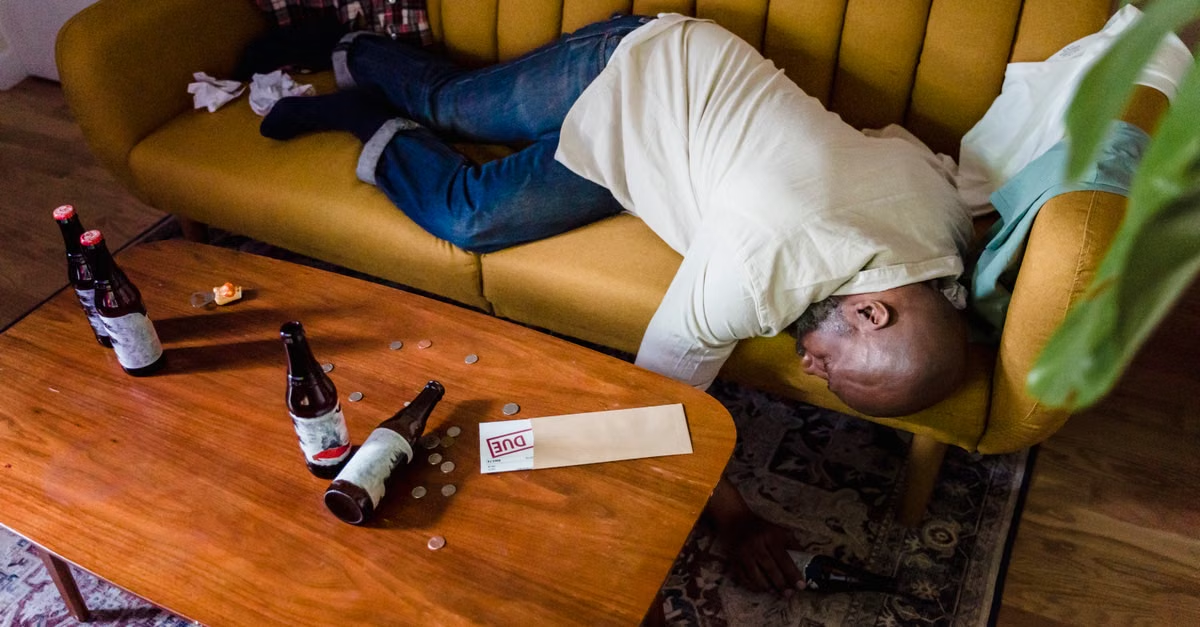
I knew the drinking had become a problem, but I had no real understanding of what was happening inside my body until illness, fear and a doctor’s blunt words forced me to confront it.

By Gogo Bathini Mbatha
The silence of a kitchen at dawn had a very different quality when I was waiting for my body to tell me what it needed.
I used to sit there while the rest of the house was still asleep, listening to the refrigerator humming in the corner and watching the darkness outside slowly soften into morning, with my hands trembling so badly that I sometimes had to hold them together.
Those mornings were not peaceful, although from the outside they might have looked like the beginning of an ordinary day. I was taking stock of myself, and more often than not I was taking stock of how much booze was left because I knew that, without it, I would struggle to get through the morning.
For a long time, I did not wake up thinking about breakfast or tea or what the day might bring. I woke up thinking about booze. Water was not part of my liquid intake at all, and food had become almost irrelevant. My first concern was whether I had enough alcohol to stop the shaking in my hands and make me feel normal enough to get through the morning. I was not drinking for pleasure anymore, and pretending otherwise would be dishonest.
My mind had also become a place I did not particularly want to inhabit when I was completely sober. I overthought everything, revisited conversations, worried about what had happened and what might happen, and found myself trapped in thoughts that seemed to grow louder the more I tried to escape them. Alcohol gave me temporary relief from all of that, and because the relief was immediate, I kept reaching for it even when I could see what the drinking was doing to me.
That is what I did not understand about my drinking at the time. From the outside, it might have looked like I was making the same terrible decision over and over again, even after the consequences had become obvious.
From inside, the decision did not always feel like a decision. It often felt like necessity. I would tell myself that I was drinking because I had had a difficult day, because I needed to sleep, because I was anxious or because I was already feeling terrible and believed another drink would settle me. I would promise myself that I would stop when things improved, and when they did not improve, I found another reason to postpone the decision.
Eventually, the distinction between wanting booze and needing it became so blurred that I could no longer say where one ended and the other began.
I had reached that point before I was prepared to admit it. The bottle had become how I dealt with everything that was going on in my head. It did not fix anything, but for a while it made me feel less overwhelmed by my thoughts and worries, and that was enough for me to keep reaching for it.
What I did not understand was how meticulously my body was keeping its own record. I could persuade myself that I was functioning, that I was still going to work, still speaking to people and still carrying on with life, but my body was recording what I was consuming and how long I had been asking it to carry a burden it was never designed to carry.
Eventually, my body revolted.
I remember the sickness because there was nothing abstract about it. I was violently ill, physically exhausted and frightened by what was happening to me, and I ended up on the cold floor, crying between heaves because I had reached a point where I could no longer maintain even the appearance of being in control.
There is a particular humiliation in being reduced to that state in my own home, surrounded by familiar things but unable to make my own body behave in a way that felt remotely familiar. I remember lying there and thinking that if I allowed myself to drift off in that condition, I might not wake up.
That thought frightened me in a way that all the previous warnings had not. I had heard people talk about the dangers of excessive drinking, and I had heard doctors warn me before, but warnings about what might happen one day had been easy to dismiss when that day had not yet arrived.
Lying there, there was no longer any comfortable distance between me and the consequences. I was looking at what alcohol had done to me while I was still alive to see it.
Going into hospital was difficult because it meant surrendering the last part of the argument I had been having with myself. There was a peculiar kind of shame in admitting that I could not manage something I had repeatedly insisted I could manage, particularly when the thing I could not manage was something I had chosen to put into my own body.
Doctors and nurses were not interested in whether I believed I had things under control. They were interested in what my body was telling them, and my body was telling a story I could no longer edit.
That was where she came to see me.
It was the second time I had encountered the physician, and she remembered me. There was nothing theatrical about her manner, which was perhaps why her words affected me so deeply. She was not angry with me, and she did not try to make me feel better about what I had done.
“Mr Mbatha,” she said, “this is the second time I have seen you here. The first time, I told you that what you are doing is a choice. Today, I am going to keep it simple.”
She then began to explain what was happening inside my body, and I remember listening to her with the strange sensation of hearing about someone else’s medical history until I could no longer pretend that the person she was describing was anybody other than me.
I had an enlarged heart. I had fatty liver disease. I had early diabetes. These were no longer warnings about what excessive drinking could eventually cause; they were conditions already present in my body.
There was a great deal going through my mind as she spoke. I was frightened and ashamed, and part of me still wanted to believe that the damage could not be as serious as it sounded. I had known enough to understand that I was taking a risk, but I had become very good at postponing the moment when I would have to confront what that risk meant.
Then she said something that left me with nowhere to hide.
“Whatever you are applying for,” she said, looking directly at me, “it is going to be approved. Right now, all of your conditions are still fixable. They are still curable. But if you want these conditions to stay permanent, carry on drinking. There is nothing more I can do for you.”
She did not say it cruelly, and she did not need to raise her voice. What made the conversation so difficult was that she was not telling me that I had run out of time. She was telling me that I still had time, and that with that opportunity came a responsibility that could no longer be handed to somebody else.
Although I had reasons for the way I had begun drinking, those reasons did not absolve me from what I was doing to myself.
September was when I decided to end the cycle.
There was no dramatic transformation and no sudden feeling that everything inside me had been put right. The hardest part of stopping was discovering how much of my life had been organised around not having to confront myself. The thoughts were still there, the worries were still there, and I had to learn to face them without reaching for a bottle.
I sometimes think about the man who sat in that kitchen waiting for another drink, and I do not find it useful to hate him. I was struggling in ways I did not know how to deal with, and I had become very good at hiding that struggle from other people and eventually from myself. That does not excuse what I did, but it helps me understand how I got there.
I cannot undo the damage or recover the time I lost. What I can do is remain sober and face whatever comes without needing to numb myself before the day has even begun.
The mornings are different now, and it is difficult to explain why something as ordinary as sitting in the kitchen with a cup of tea means so much to me unless I remember what those mornings used to be like, when I was afraid of what my own body might do to me.
I can sit at that table while the house is quiet, listen to the refrigerator humming and watch the sunlight gradually enter the room without first having to calculate how much alcohol I need to make my body feel normal.
Gogo Bathini Mbatha: Founder of Sober Beings / Traditional Healer / Researcher / Spiritual Educator.