By Themba Khumalo
On Friday 18 September, the high-ceilinged, air-conditioned dining rooms of Sandton became the setting for a particularly repulsive species of male arrogance, embodied by a man who had mistaken a fat bank balance for a licence to terrorise and who imagined that a well-cut suit entitled him to any woman unfortunate enough to be breathing the same refined air.
He arrived already convinced of his own importance and carried it through the door, where the wine is expensive and the staff are too polite to say a word.
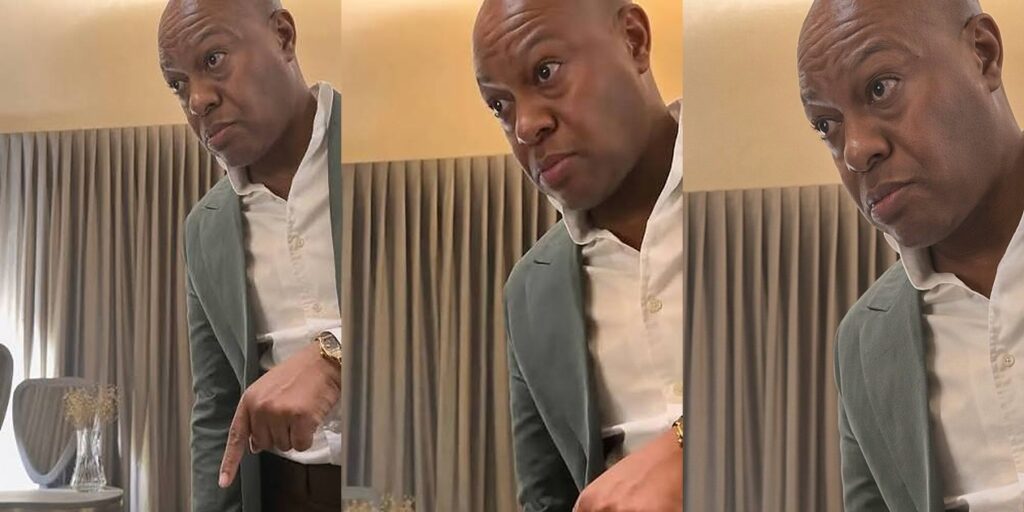
Lawrence Chamurwa Mudzinganyama, until Sunday the executive chairman of Moriel Infrastructure Group, showed us exactly what toxic entitlement looks like when nobody has ever taught it to hide. He cornered three women in the powder room at Vlamo Restaurant, the one room in the establishment where a woman might reasonably expect to be left alone. He did so because he had been offended by the one thing men of his temperament cannot endure: a woman declining him quietly and with no interest whatever in his feelings.
What followed was hardly a lapse of temper. It was the behaviour of a man who seemed to believe his money, his position, and his sense of importance gave him a special claim over other people.
“I could put a bullet in you now,” he snarled, in words captured on a smartphone he waved away with contempt. “I do not play. I will murder you now and walk… You can say no in a nice, respectful way. I’m a wealthy man. You guys are poor ladies.”
That a grown man can move from clumsy flirtation to a promise of murder because his vanity has been grazed says everything about how brittle this particular kind of arrogance can become beneath the tailoring, and it would be laughable if it were not so lethal.
In a country bleeding from an epidemic of gender-based violence, where women are butchered and abused and disposed of every day of the week, a man who backs women into a corner and talks of putting bullets in them is not having a disagreement. He is delivering, in a room where women ought to be able to close a door and breathe, the same terror South African women carry home with them every day.
However, the three women did not surrender the encounter to him. One of them held up a phone and recorded his words, preserving the evidence while he appeared to believe that his money and status made the recording meaningless. They did not need to match his volume or his bravado. They needed only to make sure that what he said could not later be dismissed as something nobody had heard.
He told them that “recording is nothing” and that he could “buy this restaurant and own it”, a boast that reveals just how much faith he appeared to place in his fortune. What he failed to grasp, even as he barked about his money, was that the women had already denied him something his wealth could not purchase: control over what had happened in that room.
The recording travelled far beyond Vlamo, carrying his own words into the public domain. He had announced that he would walk. Instead, he marched directly into the unforgiving machinery of a state that, for once, appears to have found its pace.
The ground gave way beneath him with a speed that amounts to a necessary lesson in humility. Within 48 hours of the clip going viral, the illusion of impunity lay in pieces.
Transport Minister Barbara Creecy instructed SANRAL to audit every state road agency contract linked to his infrastructure business. Public Works Minister Dean Macpherson ordered the Construction Industry Development Board to investigate his firm’s CIDB grading allocations and state tenders. Police Minister Firoz Cachalia announced that SAPS had prioritised the criminal case of intimidation while directing Home Affairs to scrutinise Mudzinganyama’s immigration status.
Prosecutors, for their part, are preparing a Section 102 process under the Firearms Control Act so that any firearm licence he holds is revoked for good.
Even his address has turned on him. In a notice to residents on Sunday, Steyn City Properties condemned “any act of violence or intimidation”, confirmed that the man in the video is one of its tenants and announced that his lease had been terminated. The estate has promised to co-operate fully with the authorities, and for a place that markets itself on safety and security, it has at least understood whom it was housing.
His employer has not waited for the courts either. On Sunday the board of Moriel Infrastructure Group removed him as executive chairman and as a director with immediate effect, barred him from acting for the company in any capacity and declared that it “unequivocally condemns violence against women”.
A man who boasted that he could buy a restaurant has discovered that a corporate title is only ever on loan from the people who can take it back.
One cannot help wondering what this country might achieve if the women who die without a viral video were granted even half of that synchronised zeal.
The man who claimed he could murder women and walk now faces criminal prosecution, regulatory probes and financial isolation, all arriving on his doorstep at the same time.
By Sunday, with his corporate empire unravelling and a date in the Randburg Magistrate’s Court looming on 1 October, Mudzinganyama retreated into the polished vocabulary of a public relations apology. “I apologise unreservedly to the women involved… The aggressive and threatening language I used was unacceptable and unjustifiable,” his statement read, before he went on to concede: “I should have exercised restraint, removed myself from the situation… I am also seeking professional guidance and will undertake an appropriate conflict-management programme.”
It is remarkable how swiftly a death threat can be shrunk into a shortcoming in “conflict management”, as though the man had merely mislaid his temper at a dinner party instead of announcing his willingness to end lives. No anger management course will undo the terror inflicted on women who wanted nothing more than an evening out, and nobody needs a certificate in conflict resolution to know that one may not threaten to execute people for declining one’s company.
His contrition reads less like repentance than the panicked scrambling of a bully who has discovered, too late and at considerable inconvenience, that his riches cannot buy off the state, the courts or the public.
The three women were not responsible for what happened to them in that room. They did not provoke the threat by refusing him, and they did not create the circumstances that followed. They exercised the most ordinary human freedom there is: the freedom to decide whom they wanted to engage with and whom they did not. When the situation turned threatening, they preserved the evidence and refused to let his version of events become the only version that survived.
No fortune, no tender and no corporate title entitles any man to intimidate, threaten or lay claim to another human being. Mudzinganyama wanted people in that restaurant to know precisely who he was, and thanks to the three women who refused to be silenced and held up a phone, the whole country now knows.
When he stands in the dock on 1 October, he will find out how brittle his boasted wealth turns out to be when it is weighed against the rule of law.
Get the morning briefing
Our editors’ choice of the day’s stories, in your inbox at six.




Comments
No comments yet.