By Themba Khumalo
He was still speaking when a whirlpool of emotions and an exhausted body forced him to stop.
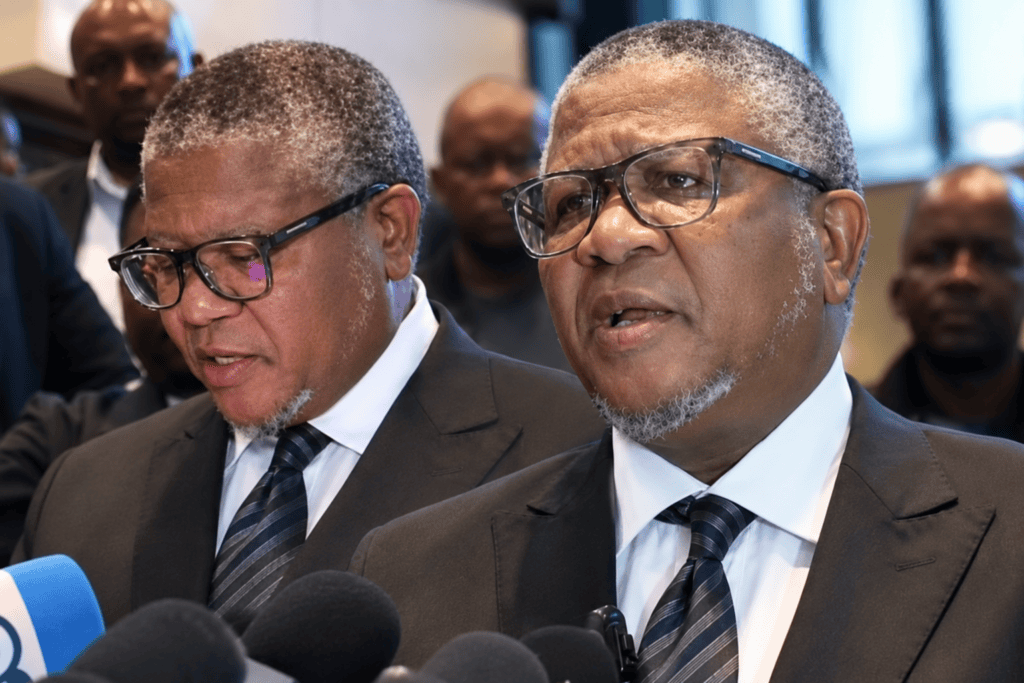
Thursday, Constitution Hill. Fikile Mbalula stood before the cameras and microphones with the verdict still ringing in his ears, and the voice that has filled a thousand political rallies began to give way. It cracked, once, then again, like a dam that has held back a month of floodwater and finally feels the pressure win. He fought it.
Anyone watching could see him fight it, swallowing, steadying himself, reaching for the next word. But the tears were stronger than the armour he has worn for decades, and they came in front of everyone, without permission and without apology.
This was not a politician performing for the cameras. It was a human being overrun by a month of fear, attacks and severe and brutal criticism, with nothing left to hold the door shut.
He kept going. The questions kept coming, and he kept answering them, sweat running down a face that had been braced for a month. Then, almost to himself: “I’m not feeling…” The sentence began but was never finished. Fikile Mbalula slumped where he stood, and the words went down with him.
I watched it, and what rose in me was not contempt. It was tenderness. Here was a man who had been holding his breath for a month, and when the verdict finally let him breathe out, everything he had been holding came out with it.
Think about what he was carrying. A hundred and eighty-one candidates, 130 on the proportional lists and 51 standing for wards, spread across six municipalities, were about to be struck from the ballot. In Port St Johns and Ngquza Hill, the party would have had no candidates at all.
The reason was a missed deadline of 28 August and a final click that did not happen the way the Electoral Commission wanted it to. One button.
Imagine being the man who has to answer for one button, with the phone ringing and the accusations arriving and the whole country waiting to see whether the oldest liberation movement on the continent would be kept off its own ballot by paperwork.
He told us the truth in seven plain words: “I had sleepless nights thinking about this.” That is the sentence I would put on the front page. It is the sound of a man who felt the fate of 181 people sitting on his chest through the long hours of the night. So when the judgment finally came, the pressure had nowhere to go but out through his eyes, and then through his knees.
There are two sides to the legal argument, and both deserve to be heard. The Electoral Commission argued that the ANC had been warned its lists were not final and had missed the deadline. The DA opposed the appeal. The Constitutional Court ruled by majority, in a judgment read out by Justice Mathopo. Argue about all of that, and argue hard. That is what courts and politics are for. But none of it has anything to do with whether a man is allowed to cry.
And yet the sneering started almost at once. Some people, whose minds run on a single broken track—a monorail with one station called “real men do not cry”—decided that the tears were a weakness. A man is not supposed to cry, they said, least of all a man who has been to the mountain.
One of them wrote: “Fikile went to an initiation school, and one of the most important attributes of a graduate is manly resistance to temperamental and emotional propensity or predisposition. In Lesotho we say ‘monna ke nku ha a lle’—a man is a sheep and won’t cry under the slaughterer’s knife. Fixit became the goat, which he is by crying under pressure, not the GOAT!”
A goat. That is what a grown man, safe behind a keyboard, calls another man for weeping after a month of sleepless nights.
Start with the mountain. I have never believed that initiation exists to turn boys into stone. It exists to make men who can carry other people: a family, a village, a responsibility. The mountain teaches endurance, and endurance is not the absence of feeling. It is feeling the whole weight and still standing.
Mbalula stood. He stood through the month, through the hearings, through the waiting, through the whispers. He stood until the load was lifted, and only then did his body give way. Anyone who cannot tell the difference between breaking under pressure and releasing it afterwards has never carried anything heavier than an opinion.
Now the proverb. A man is a sheep and does not cry under the slaughterer’s knife. Look at what is being praised. The sheep is silent because it has no choice. It goes quietly to its end, and you want to hold that up as the picture of manhood? Silence under the knife is not strength. It is what we do to animals, and it is what we have too often taught men to do to themselves, to swallow everything until it poisons them from inside. We know where that road ends. It ends in men who never speak and never heal, and who die early, or die angry, or die alone.
Besides, Mbalula was not under the knife. He did not cry out of fear for himself. He cried because 181 people had been pulled back from the edge. If that makes him a goat, then give me a whole herd of such goats, led by a man whose heart still works.
And then the matter of the GOAT. The greatest of all time was never the one who felt nothing. Ask the champions who fell to their knees at the final whistle, the captains who wept in the tunnel, the athletes who broke down on the podium. Nobody called those tears small. We called them proof of how much it mattered.
That is exactly what the sneerers miss. The tears did not show that Mbalula cared too little about composure. They showed that he cared enough about the outcome to be undone by it. I want leaders who feel the stakes. The ones who should frighten us are the men who can watch other people’s lives hang in the balance and feel nothing at all.
So to those who jeered: you are free to despise his politics, and heaven knows this country has no shortage of arguments about the ANC.
Attack the decisions, the record, the conduct of the party. That is fair game. But a man’s tears are not a policy, and they are not a scandal. They are a window, and what we saw through it was a human being at the very end of his strength, still holding on to something bigger than himself.
I would rather follow a man who can weep than one who cannot. The first knows what is at stake. The second may have forgotten that there are people at the far end of every decision he makes.
Let the man weep. It is the rest of us who should be ashamed of how quickly we forgot that strength and tenderness have always lived in the same chest.
Get the morning briefing
Our editors’ choice of the day’s stories, in your inbox at six.


Comments
No comments yet.