By Themba Khumalo
For nearly two decades, the South African state has broken its primary social contract with the tax-paying public.
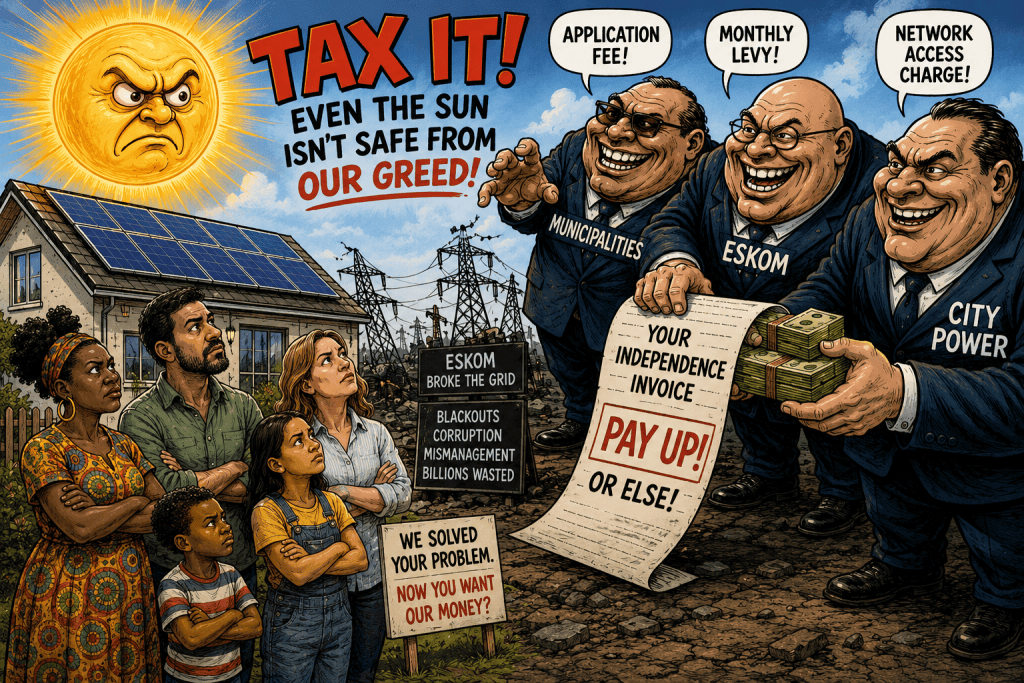
It has systematically hollowed out Eskom, collapsed the national grid, and plunged the country into a miserable, dark reality of endless blackouts.
Left entirely to their own devices by an incompetent establishment, thousands of citizens did the only logical thing to survive: they saved themselves.
They dug deep into their own pockets—paying extortionate amounts for solar panels, batteries, and inverters—just so their businesses would not collapse, their children could study, and their lives could continue to function.
We were told we were doing our patriotic duty by relieving pressure on a crippled grid. But now, having watched us rebuild our lives from the ashes of their failure, the state has decided to turn on us.
Seeing self-reliant citizens escape their clutches, the vampires of the state are looking at our roofs with predatory, covetous eyes.
This is no longer about electricity management; it is a coordinated, state-sponsored heist.
It is daylight robbery, executed under the glaring South African sun, by a parasitic political establishment so utterly devoid of shame that they have now decided to tax the very light that falls from the heavens.
READ MORE: New Tax For People With Solar Panels On Their Roofs
How dare we keep our lights on when they could not? How dare we survive without paying tribute to the municipal gods of decay?
Take the Emfuleni Local Municipality—a legendary monument to systemic collapse and financial ruin. Unable to balance its books, manage its resources, or deliver basic services, it has hatched a scheme of pure, unadulterated madness.
They want to charge households a jaw-dropping R2,400 application fee just for the privilege of installing solar, followed by a R463 monthly levy for daring to generate their own electricity.
Let that sink in. They want to tax you for not using their non-existent service.
It is a protection racket that would make the Mafia blush. “Nice solar panels you have there. It would be a shame if we had to fine you, disconnect you, or force the next buyer of your home to tear them down.”
Yes, they are actually forcing new home buyers to disconnect existing solar systems until they pay a ransom to reconnect them. It is the absolute height of bureaucratic lunacy.
But do not make the mistake of thinking this is merely the desperate thrashing of a few bankrupt, outlying municipalities. This rot has gone national.
What began as a localised cash grab has metastasised into a unified, cartel-like extortion racket.
The City of Johannesburg, the City of Cape Town, and the fossilised, corrupt behemoth of Eskom have all put aside their political bickering to agree on one sickening principle: if the citizen survives, the citizen must be punished.
They call them “network access charges,” “service levies,” and “Homeflex tariffs.”
These are not technical requirements; they are a tax on self-preservation.
It is the administrative equivalent of a protection racket, designed by the very people who broke the country’s infrastructure and are now furious that we had the audacity to build our own.
Look at how this unholy trinity is executing the squeeze:
• Eskom’s Trap: Under the guise of “modernisation,” Eskom is trying to force solar-using households onto structures like the “Homeflex tariff.”
They are aggressively hiking fixed connection fees—meaning that even if you draw zero net electricity from the grid, you are slammed with massive monthly charges.
They have also weaponised the “registration trap,” demanding complex, gate-kept engineering sign-offs that can cost tens of thousands of rand, rendering a standard, legal Certificate of Compliance (CoC) practically useless.
• The City of Johannesburg’s Double-Dip: City Power is attempting to bleed its escaping middle class dry.
While they dangle the pathetic carrot of “feed-in tariffs”, offering to buy back your excess power for a pittance, they are simultaneously scheming to burden solar households with bloated fixed service and capacity charges.
They want to pay you pennies for your clean energy while billing you pounds for the privilege of being connected to a grid that fails half the time.
• The City of Cape Town’s Bureaucratic Wall: Even under the banner of “efficient governance”, Cape Town has chosen to squeeze its solar pioneers.
Homeowners who installed solar to keep their lights on are hit with mandatory smart meter administration fees and fixed network charges.
If you do not register under their exact, expensive, and hyper-regulated terms, they threaten you with unauthorised installation fines and disconnection.
These entities are trapped in what economists call a “utility death spiral”—and they are taking their frustration out on us. As their pricing becomes more usurious and their service more erratic, more people install solar.
As more people install solar, the utilities lose money. But instead of cutting their bloated executive salaries, fixing their leaky distribution systems, or rooting out systemic corruption, their only solution is to punish the people who left.
They are raising the cost of connection so high that they are going to achieve the exact opposite of what they want: they will force self-sufficient South Africans to cut the cord entirely, leaving them with an even smaller pool of ratepayers to squeeze.
They are biting the hand that fed them, and they are doing it with a downright breathtaking arrogance.
This is no longer a matter of policy; it is a battle for our fundamental property rights. What you do behind your own property line, with your own hard-earned money and a legally certified Certificate of Compliance, is absolutely none of their business.
We have turned the other cheek for far too long. We have swallowed their hollow excuses, survived their manufactured blackouts, and paid their inflated, usurious bills.
But this? This is the final straw. If we allow these municipal bloodsuckers to tax the very sun on our roofs, we deserve the dark, feudal age they are trying to drag us back into.
If this proposal survives scrutiny, it will mark one of the most extraordinary inversions of justice in democratic South Africa.
A state that failed to keep the lights on will have discovered remarkable efficiency only when it comes to invoicing those who kept themselves afloat.
Citizens who invested their own money to preserve their homes, businesses, and livelihoods will have been rewarded not with gratitude, but with another hand in their pockets.
Policymakers should be made to defend this proposition in full public view. They should explain why prudence deserves punishment, why resilience deserves a surcharge, and why competence has become a taxable offence.
If they cannot make that case honestly, then perhaps the proposal deserves to join the long list of ill-conceived ideas that never survive the disinfectant of public scrutiny.
A government that taxes self-reliance after years of institutional failure is not merely collecting revenue. It is advertising its own bankruptcy of ideas.
And history is rarely kind to governments that mistake the patience of their citizens for an inexhaustible resource.
Get the morning briefing
Our editors’ choice of the day’s stories, in your inbox at six.

Comments
No comments yet.