

By Sandile Memela
South Africa has become a crime scene. It is no longer simply a country with a crime problem; it increasingly resembles a crime scene that happens to have the administrative and geographical boundaries of a country.
That is the uncomfortable diagnosis that author and criminologist Jackie Phamotse forces us to confront.
It is a difficult diagnosis because it requires us to look beyond the statistics, the headlines and the familiar vocabulary of corruption, murder, trafficking and organised crime. It asks us to examine what happens to a society when criminality ceases to be an aberration within the system and becomes woven into the machinery of everyday life.
In a recent no-holds-barred confessional interview on SMWX, the political podcast hosted by Dr Sizwe Mpofu-Walsh, Phamotse appeared to discuss her book The Big 5 Cartel.
The interview immediately attracted thousands of viewers, not because it was sensational, but because it was truthful in a way South Africa rarely permits itself to be. There was no comfortable distance between the storyteller and the darkness she was describing. She was not standing outside the fire and pointing at the flames; she had been burned by it.

After the interview, Mpofu-Walsh acknowledged what many viewers appeared to feel, describing the book as “enlightening but scary”. It enlightens because it explains, but it scares because it tells the truth.
The Writer Who Was Forged In Violence
Jackie Phamotse is one of South Africa’s most prolific and provocative authors, but she is also a criminologist and a researcher of the very darkness she writes about. Before there was the writer, however, there was the girl, and understanding that girl is essential to understanding the writer she eventually became.
She begins her story not with her books, but with her own body. At 17 years of age, she tells SMWX, she was sucked into the vortex of gang rape, human trafficking and violent abuse.
It was the loss of innocence in the most brutal way imaginable, at an age when a young woman should still have been discovering who she was rather than learning what human beings are capable of doing to one another.
She was a township girl with dreams who met a man who promised love and delivered hell.
What followed was a relationship that brought her to the heart of the whore, exposing her to a world in which affection became a gateway to exploitation and trust became a weapon used against her.
She consequently became an unwitting witness to a trafficking chain involving drugs, sexual exploitation and abuse that broke her spirit before she had even become an adult. She speaks of girls being drugged to the point of overdose, made to disappear and later confirmed dead.
Behind each disappearance was a human life, a daughter, a child and a future, yet within the machinery of the criminal enterprise those lives could be reduced to disposable commodities.
It is important to understand this origin because it helps explain her writing. The trauma that might have silenced her instead unleashed a writing talent she never imagined she possessed. Writing became a means of survival and a tool through which she could begin to reclaim her sanity.
In time, it became testimony and eventually part of her work as a criminologist.
Phamotse may now be a household name, but she did not become a writer to be famous. She became a writer to stay alive and then, having survived, to make sure that other girls and society itself could understand the web that was trapping them.
She is the author of the bestselling Bare series, while The Big 5 Cartel forms part of a six-part series of novels examining power. These are stories that look unflinchingly at the content of our character as a society, particularly that of men: how we raise them, what we reward them for, what we excuse and what we allow them to become.
She uses her creative energies to raise awareness and educate readers about the web of power and corruption. Her books are therefore not simply fiction. They function as case studies in novel form, constructed from the observation of a society in which the distinctions between victim and commodity, businessman and criminal, power and predation have become increasingly difficult to maintain.
The Big 5 Cartel: The Rotten Soul Of Corruption
On the surface, The Big 5 Cartel is about five criminal kingpins who control Johannesburg. They come from different backgrounds and operate across different industries, including tenderpreneurship, mining, human trafficking, drug cartels and the nightclub industry, yet together they function like a board of directors for crime.
Phamotse’s particular strength, however, lies in the fact that she does not portray these men as monsters who have somehow arrived from another world. Instead, she traces the character of criminal kingpins and examines the conditions that produce them.
They are not simply born; they are made, shaped by a post-struggle society that has progressively lost its moral compass and begun confusing wealth with worth, power with achievement and impunity with success.
The book examines the rotten soul of corruption and crime by showing how the line between legal and illegal activity has become so blurred that, in some instances, it has almost disappeared.
A tender baron and a drug lord can use the same lawyers, the same politicians and the same bodyguards, while individuals who occupy positions within the state can find themselves doing business with people operating within the underworld.
In this world, the state and organised crime are not necessarily opposite sides of a fence; they can become business partners sitting at the same table.
Through her series of novels, Phamotse documents what has gone wrong with post-struggle society.
In 1994, we thought we were building a new South Africa, a country founded upon democratic ideals, human dignity and the promise that the injustices of the past would not define the future.
What we built, Phamotse argues, was instead a marketplace in which almost everything could be bought and sold, including tenders, bodies, police dockets, influence and, eventually, souls.
The cartel in her book is therefore not simply five men. It becomes a metaphor for a country in which a small group can gather behind closed doors and divide up opportunities, resources and power that belong to more than 60 million people.
The frightening thing is not merely that such a cartel can exist in fiction, but how readily the architecture of that fiction can be recognised in reality.
The Heart Of The Whore
Phamotse’s writing gives substance to what is meant when some describe the rhetoric of the new South Africa as the heart of the whore. It is a harsh phrase, first used by an author and filmmaker, but Phamotse gives the idea flesh by placing it within the lived realities of corruption, exploitation and organised crime.
A ‘whore’, in this analytical sense, does not refer to a woman who sells sex. Instead, it describes a society that sells everything—a society that has traded its values for whatever price the market is prepared to pay. It is a society in which loyalty has a price, silence has a price, and even human life can acquire a figure on a balance sheet.
The country has degenerated into a violent crime scene because we have progressively commodified almost everything. A girl’s virginity can be priced, a police officer’s loyalty can be purchased, a murder can allegedly be ordered for R2,500, a degree can be bought, and a tender can be bought. Even justice can become something that appears purchasable if one has sufficient money to secure the right advocate.
That is the horror beneath the horror. Crime does not simply flourish when criminals become powerful; it flourishes when society begins to accept the values that make criminality profitable.
In The Big 5 Cartel, a woman is never simply a woman. She becomes currency, capable of being used to seal a deal between two kingpins, while a young girl from Limpopo can be trafficked to Sandton to entertain investors.
The physical journey from Limpopo to Sandton becomes symbolic of something much larger: the movement of innocence into a world in which wealth and power can conceal almost anything.
This is not fiction in the broader sense. The Hawks and multiple investigative reports have shown that human trafficking in South Africa is operated by syndicates whose activities can overlap with other forms of organised crime, including mining and construction mafias.
Why SMWX Matters
That Phamotse agreed to the SMWX interview is significant because the platform reaches young, black, educated South Africans who are increasingly disillusioned with both the ANC and the DA and are searching for language with which to articulate that disillusionment.
In Phamotse, they encountered someone prepared to speak about the rot without wrapping it in the polished language of political convenience.
She did not speak like a politician, nor did she speak like a victim asking for pity. She spoke as a criminologist who has lived inside the crime she studies. She spoke about how, at 17, she thought she was in love and how, by 18, she understood that she had become inventory.
Something is devastating about that transformation because, at 17, a young person should ordinarily be imagining a future, whereas Phamotse was learning that, in the eyes of the people exploiting her, her body had become an asset to trade.
Her bravery lies in the fact that she names the gendered nature of crime. These are stories that force us to examine the content of our character as a society, particularly the character of men. South African men, she argues, have been taught that power is about control and domination, that money is a means of controlling women, and that success can be measured by how many women one can buy, possess and ultimately discard.
The kingpins in her books are not impoverished men hiding in dark alleys. They are rich men who wear expensive suits, command respect and receive invitations to gala dinners. They shake hands with politicians and businessmen, move comfortably through respectable society and occupy rooms in which few people think to ask too closely where their money came from.
They are, in effect, the patriotic bourgeoisie of the criminal world, and that is precisely why they are so frightening.
A Nation That Needs To Look In The Mirror
Jackie Phamotse’s work is not comfortable reading, nor is it supposed to be. It is a dissection of a society that would often rather look away than examine the wounds beneath its polished surface.
South Africa likes to think of itself as a good country with a crime problem.
Phamotse asks us to consider a far more disturbing possibility: that we are a crime economy with a good public-relations problem.
The distinction matters because a country with crime can fight crime, whereas a country whose economy, institutions and social relationships have become entangled with criminality has a much deeper wound to heal.
The soul of the nation is not simply wounded; it is ridden with greed, misogyny and the corrosive belief that the liberation of 1994 somehow meant freedom to take whatever could be taken. The tragedy is that the promise of freedom has, for some, been reduced to the freedom to accumulate without accountability and to exercise power without consequence.
That is the uncomfortable mirror Phamotse holds up to South Africa.
Her own scars give that mirror its weight because she is not writing from an ivory tower about people she has never encountered. She has seen what happens when power strips humanity from human beings. She has seen girls turned into commodities, dreams turned into nightmares and violence disguised as opportunity.
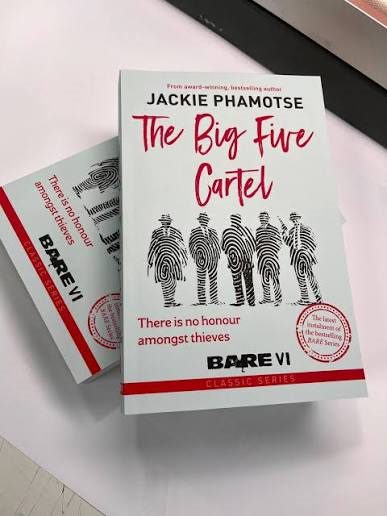
Perhaps that is why The Big 5 Cartel unsettles so deeply. It does not allow us to place evil conveniently somewhere else. Instead, it brings the darkness home and places it in boardrooms, nightclubs, mines, political networks and the respectable corridors of a society that has become remarkably skilled at looking away.
Once you understand the web of power and corruption, you can no longer pretend that you did not know. You can no longer dismiss every murder as an isolated incident, every trafficking victim as an unfortunate statistic or every corrupt transaction as merely another scandal.
That is the real terror of Jackie Phamotse’s work. It does not merely tell us that South Africa has a crime problem; it asks what kind of society we have become while crime has been allowed to flourish around us.
It enlightens because it explains.
And it scares because, once the explanation is understood, ignorance is no longer an excuse.
Sandile Memela is a writer, cultural critic and social commentator.
Get the morning briefing
Our editors’ choice of the day’s stories, in your inbox at six.

Comments
No comments yet.