
By Halima Layeni
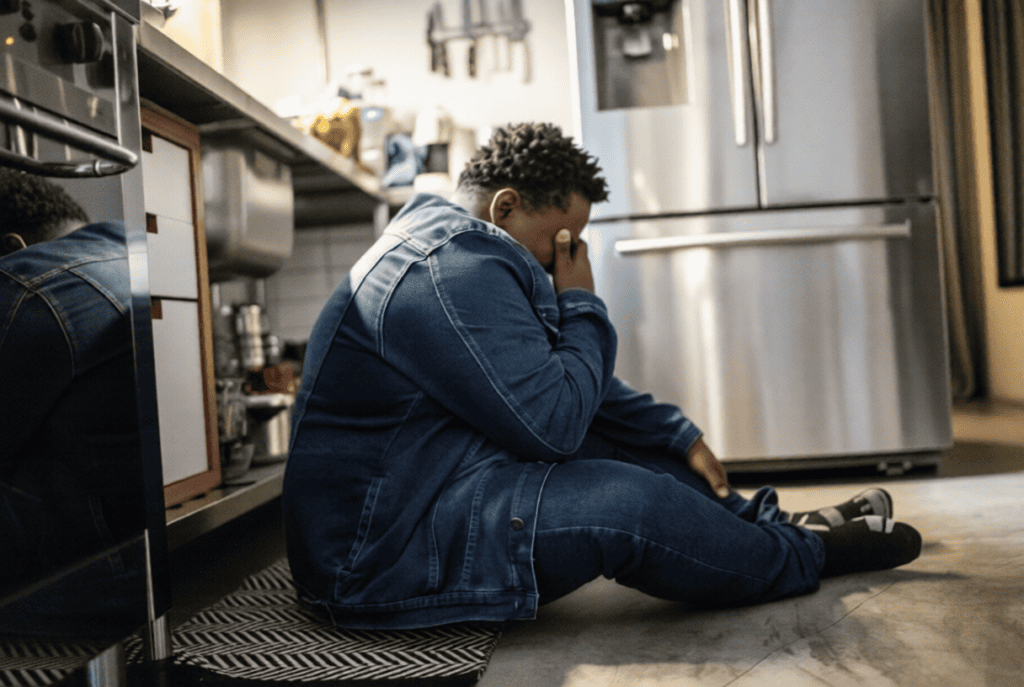
Society doesn’t know what to do with a man’s pain when a woman isn’t the one holding the wound.
The instinct isn’t cruelty. It’s confusion, then discomfort, then a scramble to redirect the conversation somewhere familiar. That’s what happens the moment a male victim speaks.
Before his sentence finishes, someone is already asking what about the women.
That question reveals something important about how society can respond to male victimisation. The problem is not that women who are hurt do not matter. They do. The problem is that their suffering is being introduced at precisely the moment a man is trying to disclose his own.
Instead of allowing his experience to be heard, understood, and addressed, the conversation is redirected. His disclosure is treated as though it needs to be placed against someone else’s suffering before it can be taken seriously.
Violence against men is also real, and men are being destroyed by it while we argue about whether they’re allowed to talk about it. Men who are abused by partners carry the same broken bones, the same bruises, the same terror that abuse produces in anyone.
They carry psychological wounds that don’t heal on their own: hypervigilance, shame, a collapse of self-trust, built by someone who claimed to love them. Some are trapped for years in control, threats, and financial entrapment they have no name for because no one ever gave them the words.
Some do not survive it. This is happening right now, to men in your own homes, schools, religious gatherings and communities, and the silence around it is not evidence that it’s rare.
It is evidence that we have built a culture that refuses to hear it.
That refusal is precisely why the redirection deserves outrage, not patience. Every time it happens, it isn’t concern for women. It’s avoidance wearing concern as a disguise.
Real concern for victims does not require silencing a male victim to make room for itself, and anyone who tells you otherwise is protecting a script, not a person. That script says there is one kind of victim and one kind of perpetrator, and when a man’s story doesn’t fit, the response isn’t to build something new. It’s to shove him back into silence and call it compassion.
Watch what actually happens when he tries. A man says his partner hit him, controlled his money, threatened to take his children if he left, and the first response is seldom about him.
It’s “well, women have it worse,” true in the aggregate and completely beside the point, standing in front of you.
Sometimes it’s a joke about him being too weak to stop a woman, which humiliates him into silence just as effectively as an argument would. Sometimes it’s a lecture on power structures, correct in theory and devastating in practice, because in that exact moment it tells him his injury doesn’t count as what it obviously is.
There is a particular reflex worth naming directly: the rush to quote statistics on violence against women underneath any post, article, or disclosure about violence against men, as though the numbers alone settle the matter and close the conversation.
This is not analysis. It is deflection wearing the costume of data. Statistics on one form of abuse do not disprove or diminish the existence of another, and citing them in that context does nothing to inform the discussion; it simply changes the subject while appearing to add rigour to the change.
Anyone quick to reach for those figures the moment a man discloses abuse should ask themselves what they are actually trying to accomplish, because it is rarely a fuller understanding of victimisation. More often, it is an attempt to reassert whose pain is allowed to occupy the room, dressed up as a factual correction.
And it doesn’t stop there. Bring up a man beaten by his partner, and someone will pivot to male violence statistics, as if his personal suffering has to be weighed against the conduct of every other man before it’s allowed to matter.
He is not on trial for his sex. He is a victim standing in front of us, and forcing him to answer for other men’s actions before we believe his own is not caution; it’s cruelty with better branding.
Every one of these pivots teaches him something, and he learns it fast, and he learns it permanently. He learns his pain is conditional. He learns disclosure is a matter of timing, not honesty, and he picked the wrong moment.
He learns his suffering can be tabled, minimised, and redirected, and that no one will call that a harm in itself.
Eventually he stops testing whether this time will be different, because he has no reason left to believe it will be.
That is not resilience. That is a man being trained, conversation by conversation, that silence is the only safe option left to him. And silence is killing men. We cannot keep pretending otherwise.
If the only time violence against men gets acknowledged is as a detour back to violence against women, that was never protection for women’s cause. It was a decision, made over and over without anyone admitting it out loud, about whose pain gets to be an emergency and whose gets treated as an inconvenience.
No movement that claims to stand for all victims gets to treat one category of victim speaking as a problem to be managed. That is not solidarity. That is triage based on which victim is easier to believe.
Suffering is not a fixed pie. One man’s pain does not shrink a woman’s claim to sympathy, and pretending it does is exactly what has kept this entire conversation frozen for decades.
Abuse is not a competition, and every day we keep treating it as one, we fail every single person it claims to protect, including the women we tell ourselves we’re defending by silencing him.
Men’s suffering deserves to be discussed on its own terms, now. It deserves its own space to examine the shame, the disbelief, the total absence of services built for him, because that is the only way any of it actually gets fixed instead of buried.
The fix is not complicated. It is uncomfortable, and it is overdue.
When a man says he was hurt, let that be the whole sentence. Not a debate opener. Not a cue to protect someone else’s feelings first. A fact, sitting on its own, exactly the way we’d let it sit if a woman had said it.
Every redirection costs another man his voice, and some of them are paying for that silence with their lives. If you have ever deflected a man’s disclosure, stop today, the next time it happens.
Change starts with the response itself. It starts with the next person who hears a man say he was hurt and lets that sentence stand instead of reaching for a comparison. It starts with refusing to let “what about the women” be the reply every time, and recognising that reflex for what it is rather than mistaking it for concern.
A male victim finally spoke. Whether anything has actually changed will be measured the next time it happens, and by whether society, this time, lets him finish.
Halima Layeni: Speaker | Global Voice For Men’s Mental Health & Policy Reform | Author of Dear Man | Executive Director, Life After Abuse Foundation | Mental Health Coach For Professionals | U.S. Consul General Award Recipient
Get the morning briefing
Our editors’ choice of the day’s stories, in your inbox at six.


Comments
No comments yet.