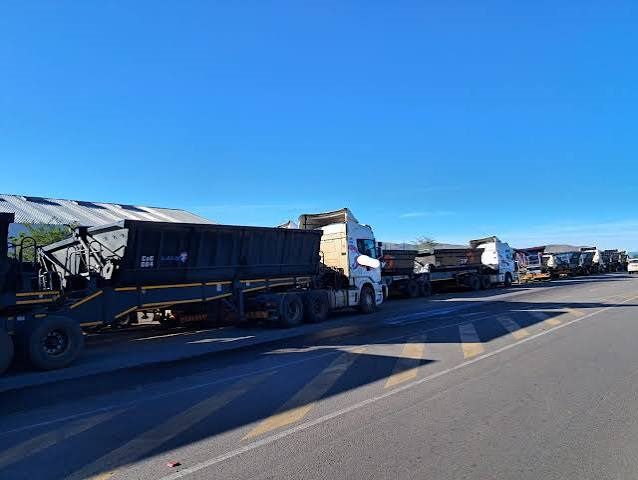
Stand beside any main road in Sekhukhune long enough, and a truck will thunder past, loaded to the brim with chrome or platinum, headed for a port, a smelter, a factory somewhere far away.
Stand a little longer, and another one follows, just as full. Somewhere in the world, those minerals become cars, jewellery and phones.
Here, the road they leave on is cracked, the clinic is a long walk away, and the young man standing next to you has a matric certificate and no job.
The trucks leave carrying our wealth. Our villages are left with poverty.
Sekhukhune sits on some of South Africa’s richest mineral ground and is home to many mines. Yet the communities around those mines live with high unemployment, poverty, poor infrastructure and almost no real share in the value taken from their land.
That is what economic exclusion looks like. It is not an abstract idea. It is the gap between what leaves on the trucks and what stays behind.
This is why our community wrote to the President and the Minister of Mineral and Petroleum Resources. We were not writing in the heat of a protest. We wrote because people raise honest concerns about jobs, contracts, ownership, environmental damage, and broken development promises, and too often they are treated as obstacles rather than as people with a stake.
A grievance about hunger and work gets met with police and security vehicles when it should be met with a conversation, open rules and a fair chance to take part in the economy.
We did not ask for confrontation. We asked for seven things.
First, a review of how long mining rights last. A mining right can run for decades, and renewal can feel like a formality. We are asking government to look again at how rights are given and renewed, and to attach conditions that can be measured. Before a company’s right is renewed, it should show what it has done for local employment, local suppliers, fair transformation, environmental protection and development in the surrounding villages. A right to dig up the country’s wealth should be earned and kept through performance, not simply by having been first in line.
Second, an independent audit of mining rights in Sekhukhune. Companies agree to conditions when they are approved. They promise to meet environmental standards, to follow their community plans and to meet transformation requirements. Nobody outside the mine can easily tell whether they have. We want independent technical and legal experts to check, mine by mine. Where serious failures are found, the law must be applied. We are not asking for punishment without proof, only for proof, and then for the law to take its course.
Third, real ownership for host communities. We want practical ways for the people who live beside the mines to hold a protected, legal share in what those mines earn. Consultation is not enough. Most of us know how a consultation goes: we are invited, we speak, we are thanked, and the decision is made somewhere else. Being asked is not the same as being counted. People who share the land with a mine should share in what comes out of it.
Fourth, a lawful path for small-scale and artisanal miners. There are local people who have the skill and the will to mine and who would gladly do it legally. But the permit system is so complicated and so expensive to navigate that it shuts them out, and some end up working illegally because there is no other door. We want a clear, open way for genuine small-scale miners to get permits and join the formal economy. This benefits government too, because people on the right side of the law are easier to work with than people forced to stay outside it.
Fifth, local jobs and local suppliers. Mines make promises to hire from the area, train local people and buy from local businesses. Those promises are often what communities were counting on when the mine was approved. We want them monitored properly and enforced, and we want the results published so that anyone can see whether a mine kept its word.
Sixth, open books on the mines’ community promises. When a mine is approved, it also writes a plan for what it will do for the surrounding community. These are called Social and Labour Plans, but what they really are is a list of promises. Communities should be able to find out what was promised, how much was spent, when it was supposed to happen and what has actually been delivered. If a mine is keeping its word, it loses nothing by showing us. If it is not, we have a right to know.
Seventh, talk before force. Economic complaints should not automatically be treated as security problems. Before sending in security forces over a dispute or a protest, we ask government to engage the legitimate community representatives and the traditional and civic structures first. A protest is often the last thing a community does after every other door has stayed shut. Listening early costs less than clearing up afterwards.
None of this is a case against mining. Mines bring wages, skills and, in many places, the only formal work for miles around, and we are not asking anyone to switch them off. We are asking for rules that are fair, enforced and honest. Even on enforcement, our letter says action must follow “in accordance with the law”.
We want due process for the mines as much as for ourselves, and we want the same for the people we ask government to speak to, which is why we say “legitimate” representatives and not whoever shouts loudest.
Our central demand is simple. Sekhukhune’s mineral wealth cannot go on sitting beside widespread economic exclusion. The minerals beneath our land are a national resource, and we accept that. But national ownership should never become an excuse for the people living closest to the wealth to remain permanent spectators, watching it leave on the back of a truck.
So we have asked for an urgent, high-level meeting that brings the Presidency, the Department of Mineral and Petroleum Resources, provincial and local authorities, the mining companies and the affected communities of Sekhukhune into one room.
We have also asked the Department for a written reply that states plainly what systems already exist to deal with these concerns and what more government is prepared to do.
The minerals beneath our land belong to the nation, and we have never said otherwise. But we will not stand at the roadside forever, watching our own wealth go by. We have asked for a meeting and a written reply. We are waiting for both.
The trucks are full. Our villages are not. That is the whole case, and it is why we wrote.
Get the morning briefing
Our editors’ choice of the day’s stories, in your inbox at six.



Comments
No comments yet.