
By Sandile Memela
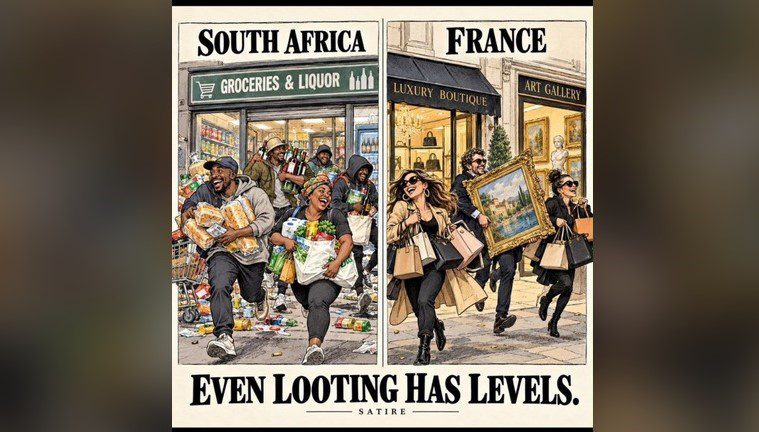
The above image—EVEN LOOTING HAS LEVELS—is painful because it is true in its lie.
It tells a joke that is not funny. On the left, Black South Africans run with bread, toilet paper and groceries. On the right, white French people run with luxury handbags and a painting from an art gallery.
Superficially, it is about looting. Actually, it is about what capitalism has taught different races to desire.
Let us contrast it honestly.
South Africa: Looting For Survival
In July 2021, the world saw South Africans loot retail and liquor stores. Bread, maize meal, cooking oil, meat, TVs, fridges. Why?
Because in South Africa, poverty is still Black, and it is still about basics.
When the state collapses, when Zuma is jailed, when there is no grant that week, the Black poor do not run to Louis Vuitton; they run to where the food is. It is not a political statement. It is a stomach statement.
It signifies that for the Black working class, the economic system is so exclusionary that even in rebellion, the imagination is limited to survival. You steal what you cannot afford to buy that day. You are not challenging the system. You are trying to eat inside it.
France: Looting For Status
In France – the 2023 Nahel riots, and before that the Yellow Vests – looters hit Nike stores, Chanel, Apple, galleries. And these past few weeks, the pattern has been the same. Why?
Because in France, even the poor have the basics covered by the welfare state. The poor are not starving. They are excluded from luxury—from the symbols of being French, being white, being equal. So they loot the handbag, the artwork, the status object. It is looting to belong.
It signifies that white privilege even inverts looting. White poverty still has an aspiration to luxury. Black poverty in South Africa still has an aspiration to bread.
That is the racial and class difference the satire is pointing to.
But Both Are Not Revolution
Of course, their behaviour and attitude point out that all are barbarians at the gate. In fact, the aspirations are the same. It seems it is not about bringing down the system but about getting what they can for themselves.
Selfishness and greed, you can call it.
Exactly.
A revolutionary burns the grocery store and the luxury boutique. A looter steals from them.
The French looter stealing a painting does not want to abolish private property in art. He wants to own the art.
The South African looter stealing bread or groceries does not want to abolish Woolworths or Checkers. He wants to be able to shop at these retail shops.
In both cases, looting confirms the system; it does not challenge it. It says: Your system is correct; I just want my share of it, even if I have to steal it.
And this is why this conduct and behaviour do not make them different from politicians and their rulers, who are in it for themselves too.
What does a corrupt politician do? He does not want to bring down the tender system. He wants to win the tender or give it to his proxy. He does not want to destroy Parliament. He wants a seat to eat in it.
What does a looter do? He does not want to destroy the mall. He wants what is in the mall. The #FeesMustFall leaders wanted to be inside the system. And they were absorbed and shut up.
Both are extractive. Both are individualist. Both say: The house is burning; let me grab the TV before it falls.
The Myth Of White Privilege In Looting
The satire says, “Even looting has levels.” The deeper truth is: even inequality has levels.
White privilege means that even when white people break the law, they break it upwards – towards excess, towards art, towards luxury. Black deprivation means that even when Black people break the law, they break it downwards – towards need.
But neither is challenging the economic system. Both are products of it.
Capitalism has succeeded in making even our rebellion consumerist. In France, you rebel by shopping without paying. In South Africa, you rebel by shopping without paying. The only difference is the shopping list.
That is why the image hurts. It is not about looters. It is about what 400 years of racial capitalism has taught us to want.
The French have been taught to want luxury as identity.
The South Africans have been taught to want bread as victory.
Until we want something beyond both – a system where neither bread nor art needs to be looted – we will keep seeing the same image, just with different crowds.
And yes, the politicians will be watching from above, looting the treasury in a suit, which is just looting with levels too.
Get the morning briefing
Our editors’ choice of the day’s stories, in your inbox at six.



Comments
No comments yet.