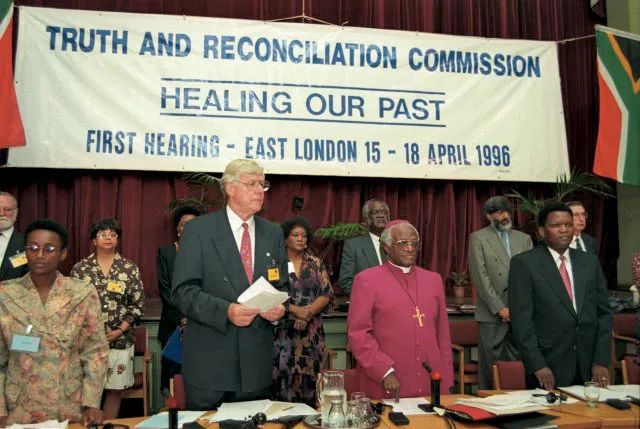
Reconciliation cannot demand that the bereaved carry the burden of silence. While Thabo Mbeki’s personal losses deserve empathy and recognition, families seeking answers about apartheid-era crimes are entitled to question why the TRC’s recommendations went unpursued, and to demand accountability without being mistaken for advocates of revenge.
By Themba Khumalo
Sandile Memela’s History Will Have To Judge Thabo Mbeki asks us to look beyond the familiar image of the former president and recognise a father and brother who suffered devastating personal losses.
It is a necessary reminder that behind the political figure is a human being. Mbeki lost his son, Monwabisi Kwanda, who disappeared in 1981, and his brother Jama, who was killed the following year. Neither loss can be measured against the other, and neither should the passage of time diminish them.
Read more: History Will Have To Judge Thabo Mbeki
But compassion for Mbeki cannot be the end of the conversation. It must also extend to the thousands of South Africans whose loved ones disappeared, were tortured or were murdered under apartheid, and whose families have spent decades waiting for answers, accountability and justice. Some have never recovered their relatives’ remains. Others know who was responsible but have watched the years pass without seeing those responsible brought before a court.
Their grief is not less deserving because it has taken a different shape from Mbeki’s. Nor are they irrational for refusing to accept that the demands of nation-building should bring their search for justice to an end.
Memela presents Mbeki’s alleged role in protecting apartheid-era perpetrators against the painful backdrop of his own losses. He asks us to consider the moral weight of the choices made by the ANC leadership as it negotiated the transition from apartheid to democracy. That history deserves to be taken seriously. The movement was confronting an extraordinarily difficult task: ending a system built on racial domination while preventing the country from descending into further bloodshed.
Nelson Mandela, Mbeki and others made profound personal sacrifices in pursuit of freedom. The compromises of that period cannot be understood honestly without acknowledging the dangers they faced and the future they hoped to secure.
But acknowledging those dangers does not require us to treat every decision made in the name of peace as beyond reproach. Nor does it mean that those who question the consequences of those decisions are ungrateful for freedom or indifferent to the sacrifices that secured it.
The question is not whether South Africa needed peace. Of course it did. The question is whether peace required families to live indefinitely with unanswered questions, whether national reconciliation could be built on the abandonment of further investigations, and whether the democratic state fulfilled its obligations to victims when the TRC recommended prosecutions.
These are not abstract questions. They concern real people who went to the Truth and Reconciliation Commission, told their stories and placed their hopes in a process that promised the country a way of confronting its past. The TRC was not established merely to record suffering. Its work included investigating human rights violations, establishing the truth and making recommendations intended to help prevent impunity.
Where prosecutions were recommended, the expectation that the state would pursue those cases was not an unreasonable demand for revenge. It was a demand for accountability.
That distinction is crucial.
A family asking for a murder to be investigated is not necessarily asking for blood. A daughter who wants to know where her father was buried is not seeking vengeance. A mother who wants those responsible for her son’s disappearance to answer questions in court is not trying to destroy the country her son died fighting to liberate. These families are asking the democratic state to recognise that their loved ones mattered, that their lives were not disposable and that the promises made in the name of reconciliation applied to them, too.
Their wounds do not become less painful because a president has suffered similar losses. If anything, Mbeki’s own history should make the anguish of these families more comprehensible, not less deserving of an answer.
There is something deeply troubling about the suggestion that the failure to pursue justice can be understood primarily through the personal burden carried by those who made the political decisions. Mbeki’s grief may help us understand the human cost of his choices, but it cannot establish whether those choices were right. His suffering is not evidence that the state did everything it should have done. Neither is his personal sacrifice a substitute for accountability.
Memela writes that Mbeki chose not to avenge his son, and presents that choice as an act of extraordinary restraint. There is moral force in the refusal to answer one death with another. South Africa did not need a former president to use state power to settle personal scores. But prosecuting alleged perpetrators through lawful processes is not the same as revenge. It is precisely the alternative to revenge that a constitutional democracy is supposed to provide.
There is a fundamental distinction between revenge and justice, and South Africa’s history makes it imperative that we do not confuse the two. Revenge is driven by the desire to inflict suffering in return for suffering, to settle a personal score or to make another person pay outside the proper bounds of the law. Justice, by contrast, demands that allegations be investigated, evidence be examined, responsibility be established through due process, and those found guilty be held accountable in accordance with the law. It is not the pursuit of another person’s suffering; it is the insistence that no one should be beyond the reach of the law.
To reject revenge is a moral choice. To demand justice is a legitimate expectation in a constitutional democracy. One does not have to avenge a murdered son to insist that his killers be investigated and, where the evidence warrants it, prosecuted. One does not have to answer a disappearance with another act of violence to demand to know what happened, where the remains lie and who was responsible. Indeed, it is precisely because we reject private vengeance that we need credible investigations, independent prosecutors and courts capable of determining guilt fairly.
This is why the distinction matters in the case of Thabo Mbeki and the families still seeking accountability for apartheid-era crimes. No one should suggest that Mbeki ought to have used the power of the presidency to pursue his son’s alleged killers for personal retribution. But that is not the question these families are asking. Their question is whether the democratic state did everything within its lawful power to pursue the cases in which the Truth and Reconciliation Commission recommended prosecution.
To frame that demand as a threat to reconciliation is to confuse accountability with vengeance. Prosecution, where supported by evidence and conducted through due process, is not a repudiation of peace. It is one of the ways a democratic society demonstrates that peace does not mean impunity, that reconciliation does not require silence and that the lives taken under apartheid still matter under the democracy built in its aftermath.
Mbeki’s refusal to seek personal revenge, if that is how we understand his choices, may command respect. But it cannot, by itself, answer whether the state fulfilled its obligations to other victims. The moral restraint of an individual and the legal responsibilities of a government are two different matters. We can honour the former without abandoning scrutiny of the latter.
And this is where the debate becomes uncomfortable. If prosecutions recommended by the TRC were not pursued, the families affected are entitled to ask why. They are entitled to scrutinise the conduct of successive administrations, including Mbeki’s. They are entitled to examine whether political considerations interfered with the pursuit of accountability. Those questions cannot be answered by invoking the fear of civil war or by reminding the bereaved that the country might otherwise have descended into chaos. Such fears may have been genuine, but they cannot, on their own, settle the matter.
We must be careful, too, not to turn the ANC’s historical struggle into a shield against legitimate scrutiny. The movement played a central role in defeating apartheid and establishing democracy. Its leaders endured imprisonment, exile, persecution and the loss of loved ones. Their sacrifices deserve recognition. But the liberation struggle was not fought so that the state could eventually ask the families of its victims to accept that justice had become an unaffordable luxury.
Freedom was supposed to mean more than the right to vote and the privilege of living under a democratic Constitution. It was also supposed to mean that the law would no longer protect the powerful at the expense of the powerless. For families whose cases remain unresolved, that promise has not been fully realised.
South Africa is not divided between a grieving Thabo Mbeki and families who refuse to understand his pain. It is a country in which grief has taken thousands of different forms. Some people have learnt to live with uncertainty. Others cannot make peace with the fact that those who destroyed their families may have lived out their lives without answering for what they did. Some carry scars that have healed over. Others are still bleeding. We have no right to prescribe how long they should mourn, when they should forgive or what form their reconciliation should take.
Nor should we romanticise the loneliness of a leader who carries his pain in silence while overlooking the families who have had to carry theirs without answers. Mbeki was entitled to his grief, and he did not have to turn it into a public spectacle to prove that he suffered. But the families of the disappeared and murdered are equally entitled to speak, to question and to demand that the state account for what it did or failed to do.
There is no need to deny Mbeki’s humanity to confront the consequences of his presidency. Indeed, taking his humanity seriously means allowing him to be judged as a human being who made political choices, rather than placing him beyond criticism because those choices were made in a time of extraordinary difficulty. We can acknowledge the burden of his losses without assuming that every decision he made was justified by them.
Memela concludes that both the families who believe justice was sacrificed and those who believe the compromise secured peace may be right. It is an empathetic attempt to hold two painful truths together. But there is a danger in leaving the argument there. If both sides are simply declared right, the question of responsibility remains suspended, and those who have waited longest for answers are left where they have always been.
Reconciliation cannot mean that every grievance must eventually be absorbed into a national story of sacrifice and forgiveness. Nor can it mean that the passage of time absolves the state of its obligations. A country cannot undo the crimes of its past, but it can decide whether to investigate them, whether to pursue credible evidence and whether to honour the recommendations made by the commission it established to confront them.
Thabo Mbeki’s son deserved to be found. His brother deserved justice. So did every other victim whose family went to the TRC in search of truth. One family’s suffering cannot cancel out another’s, and the pain of a former president cannot answer for the failures of the state.
History will judge Mbeki. It must also judge the institutions and political leaders who determined whether the pursuit of justice continued after the TRC completed its work. But history should not be the only judge. For the families still waiting, justice delayed is not a historical abstraction. It is the unanswered knock at the door, the grave that has never been found, the name that still carries an unbearable question.
We owe those families more than sympathy. We owe them an honest accounting of what happened, why prosecutions were not pursued where they were recommended, and what can still be done.
Peace was an achievement. Freedom was an achievement. Neither should be diminished. But neither should be used to silence the people who are still waiting for justice.
A nation cannot ask its wounded to carry the burden of reconciliation alone. And it cannot call the past settled while so many of its people are still waiting for the truth.
Get the morning briefing
Our editors’ choice of the day’s stories, in your inbox at six.



Comments
No comments yet.