By Themba Khumalo
While much of world football has reacted to FIFA’s latest governance crisis with fury, the Confederation of African Football has once again retreated into its favoured, tragic role: that of the reliable lapdog.
Faced with a scandal that should have prompted Africa’s football governing bodies to demand answers, CAF has instead rushed to offer Gianni Infantino its unwavering support, turning what should have been a moment of institutional reckoning into another display of unquestioning allegiance.
It is an own goal scored deliberately, then celebrated from the bench.
The offence in question is no minor administrative slip; it is a brazen attempt to privatise the commercial crown jewels of the beautiful game. Infantino’s scheme to sell stakes in future World Cup revenues to private equity firms was hatched in darkness, pursued without proper oversight by the council, and abandoned only when it was exposed and the ensuing outrage became impossible to contain.
Across much of world football, the response has been one of anger and alarm, with governing bodies, player representatives and national associations demanding to know how such a scheme could have been conceived and pursued without the scrutiny of those entrusted with FIFA’s governance.
UEFA has rightly maintained that its members remain prepared to boycott FIFA competitions, CONCACAF has demanded a comprehensive reckoning, and FIFPRO has called the manoeuvre what it is: a profound abuse of presidential authority.
From London and Madrid to Belgrade and Helsinki, football associations have made their positions clear: a midnight apology squeezed out under pressure does not repair the institutional damage, particularly when that apology, issued jointly by Infantino and FIFA secretary general Mattias Grafström, amounts to an admission that council members and national federations were excluded from a process in which they should have had a voice.
An admission that mistakes were made does not answer the deeper question of how those mistakes became possible in the first place. The football world is asking that question. CAF, astonishingly, appears more interested in defending the man who should be answering it.
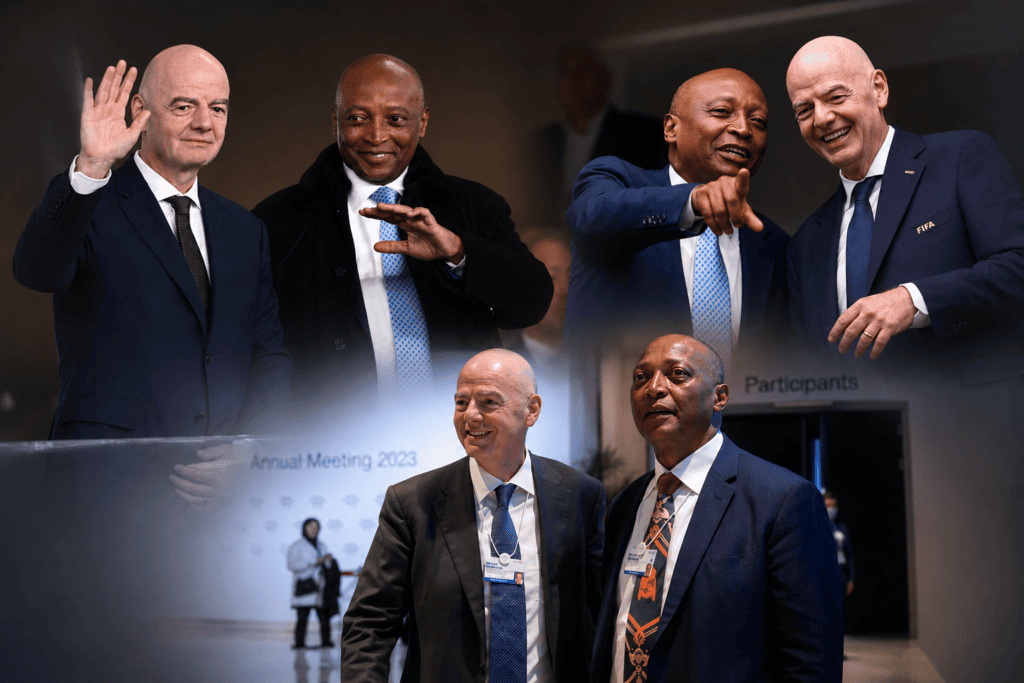
Yet in Rabat, Morocco, Patrice Motsepe and CAF’s Executive Committee surveyed this institutional wreckage and chose to close ranks around Infantino, offering him precisely the kind of political protection that a governing body should be demanding for the principles of governance rather than for the individual accused of undermining them.
To hear Motsepe speak of “adherence to governance, due process, and transparency” while CAF simultaneously shields the man whose conduct has raised questions about all three is an exercise in breathtaking cynicism. Corporate vocabulary does not become a governance principle because it is repeated solemnly; indeed, when the language of transparency is deployed to defend opacity, it begins to sound less like principle and more like camouflage.
You cannot posture as the guardian of the rulebook while acting as the clean-up crew for the man who appears to have treated it as an inconvenience. You cannot demand that football’s institutions be respected while showing such extraordinary reluctance to interrogate the conduct of the man at the very top of the game.
And you certainly cannot expect the rest of the football world to believe that governance matters when your response to a governance crisis is to circle the wagons around the person at its centre.
What makes the spectacle even more extraordinary is the language of personal loyalty that has been placed at the heart of it.
Motsepe’s declaration that he will not “stab Infantino in the back” because the Swiss administrator is a “loyal friend” might be perfectly understandable in a private conversation between two people who have developed a close relationship. But football administration is not a schoolyard friendship pact, and CAF is not a fraternity whose principal obligation is to ensure that one of its friends never feels abandoned when the pressure begins to mount.
A football governing body cannot approach institutional accountability with the emotional logic of a dressing room. Friendship may determine who gets invited to dinner; it cannot determine whether an institution demands answers from the person occupying one of the most powerful offices in world football.
The moment personal loyalty becomes the standard by which institutional conduct is judged, the game changes completely, because the question is no longer what is right for football but what is comfortable for those who happen to be close to power.
That is what makes the chorus from across Africa so dispiriting. Morocco’s Fouzi Lekjaa, Egypt’s Hany Abo Rida, Niger’s Hamidou Djibrilla, Mauritania’s Ahmed Yahya and FECOFA’s newly elected president Veron Mosengo-Omba have all dutifully fallen into line, producing statements whose striking similarity makes them sound less like independent institutional judgments than a carefully rehearsed team talk delivered before the players walk onto the pitch.
Perhaps they genuinely believe Infantino is right. Perhaps they genuinely believe the controversy has been exaggerated. Perhaps they genuinely believe his apology settles the matter. But when influential football administrators across an entire continent move with such synchronised certainty to defend one man at precisely the moment when other major football institutions are demanding scrutiny, the spectacle becomes difficult to distinguish from a team instructed to protect its captain regardless of what has happened on the pitch.
And that is where CAF’s conduct becomes more than embarrassing. It becomes an extraordinary squandering of power.
Africa has 54 member associations, second only to Europe’s 55, accounting for more than a quarter of FIFA’s 211 votes. That is not a decorative collection of numbers to be wheeled out during elections and then put back in the cupboard.
It is a kingmaker’s bloc, one capable of influencing the direction of global football, demanding commercial transparency, insisting on proper governance and extracting meaningful concessions for a continent that has spent decades complaining, with considerable justification, that its importance to world football has never been matched by its influence over the institutions that govern it.
Yet when the moment arrives to use that leverage, CAF seems determined to play itself out of the game.
This was the moment to ask difficult questions, to demand proper explanations and to make clear that Africa’s support for FIFA cannot be treated as a blank cheque for whoever occupies the presidency. Instead, CAF has effectively handed over its bargaining chips without even asking what it is receiving in return, surrendering possession at precisely the moment when it should have been driving towards the penalty area.
There is an almost painful absurdity to it. Africa has the numbers to be a decisive force in world football, yet its governing body repeatedly behaves as though it is grateful simply to be invited into the dressing room. It possesses enough votes to make FIFA presidents listen, yet appears content to make sure they are comfortable. It has the political weight to demand accountability, yet chooses the safer position of standing behind the incumbent and hoping that proximity to power will eventually be mistaken for power itself.
That is the real humiliation.
CAF is not being pushed to the sidelines by some superior European force. It is walking there voluntarily.
By rushing to rehabilitate Infantino while Prince Ali bin Al Hussein, Amnesty International and major European federations demand institutional hygiene, CAF has chosen where it wants to stand when the whistle blows.
It has decided that the safest place is not alongside the principles that are supposed to govern football but alongside the man who currently controls the most powerful office in it.
And there is a profound difference between defending FIFA and defending Infantino. One is loyalty to an institution; the other is loyalty to an individual. When those two things become indistinguishable, institutional accountability becomes little more than theatre, because the person at the centre of the controversy no longer has to answer only to the rules. He has friends willing to defend him before the questions have even been properly answered.
That is why the “loyal friend” argument is so revealing. It tells us that the currency being traded here is not principle but allegiance. It tells us that when the game became uncomfortable, CAF did not ask which side of the rulebook it should occupy; it asked which side of its friend it should occupy.
For an organisation entrusted with the interests of 54 African football associations, that is an astonishing choice.
Africa does not need a seat at FIFA’s table simply to nod when Zurich speaks. It does not need 54 votes so that they can be marshalled behind the incumbent whenever his authority is challenged. It certainly does not need a continental governing body whose greatest demonstration of strength is the speed with which it falls into line.
CAF should have walked into this crisis with the weight of African football behind it and demanded that the game’s rules apply equally to everyone, including the man at the top.
Instead, it has chosen to mark its man, protect its man and play the match on his terms.
When forced to choose between standing up for the integrity of the beautiful game and kneeling before incumbent power, African football’s leadership appears once again to have reached for its knee pads.
And somewhere in Zurich, the applause must be deafening.
Get the morning briefing
Our editors’ choice of the day’s stories, in your inbox at six.
Comments
No comments yet.