By Staff Reporter
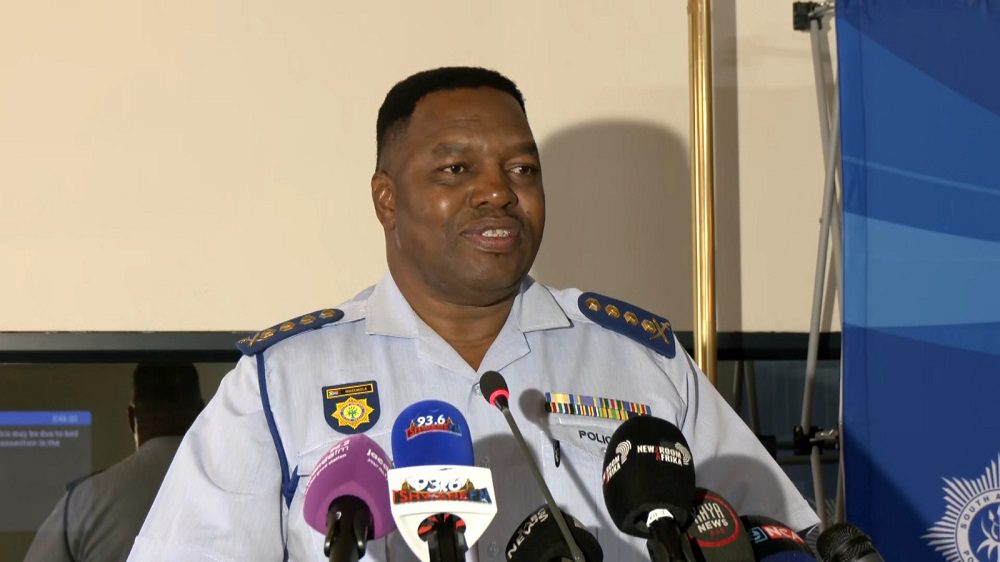
National Police Commissioner Fanie Masemola has returned to work, pledging to strengthen frontline policing, restore public confidence in the South African Police Service (SAPS) and tackle crime after criminal charges against him were withdrawn last month.
Masemola resumed his duties on Monday, 19 October, after President Cyril Ramaphosa lifted his precautionary suspension on Friday, 16 October.
Addressing senior police officers at the Tshwane Academy on his first day back, Masemola said his return was an opportunity to reinforce the rule of law, accountability and stability within the police service.

“This day holds great significance, not because an individual has returned to office, but because it presents an opportunity to reaffirm our commitment to the rule of law, institutional stability, accountability and the national interest,” he said.
Masemola was suspended in April after appearing in the Pretoria Magistrates’ Court to face four charges of contravening the Public Finance Management Act (PFMA). The charges related to a controversial SAPS healthcare contract awarded to Medicare24 Tshwane District, a company linked to businessman Vusimuzi “Cat” Matlala.
The contract, initially valued at R228 million and subsequently reported as worth R360 million, was intended to provide health services to police officers. The allegations against Masemola centred on his responsibilities for financial oversight and compliance with procurement rules.
Ramaphosa announced the precautionary suspension on 23 April, saying it was necessary given the seriousness of the charges and the national commissioner’s responsibility for leading the fight against crime.
The National Prosecuting Authority (NPA) ordered the charges withdrawn on 15 September following a review by National Director of Public Prosecutions Advocate Andy Mothibi. The Pretoria Magistrates’ Court formally withdrew them on 22 September.
The NPA said its review considered evidence gathered by the Investigating Directorate Against Corruption, a report by a case assessment panel and an assessment by independent senior counsel. Mothibi concluded that there were no reasonable prospects of a successful prosecution against Masemola on the PFMA charges.
The NPA also said the circumstances surrounding the prosecution would be referred for further scrutiny to establish whether there had been misconduct in the assessment and enrolment of the case.
Masemola thanked Ramaphosa for lifting the suspension and South Africans who supported him during his absence, particularly his family.
He said the experience had reinforced the importance of due process and fairness, adding that the police service needed to remain focused on its constitutional responsibilities.
“My experience has reinforced the importance of due process, fairness and respect for the rule of law. Ultimately, the truth must prevail, and institutions must be guided by evidence, integrity and justice,” he said.
Masemola said he would not allow the circumstances surrounding his suspension to distract the SAPS from its work. His priorities, he added, included uniting the organisation, strengthening leadership and accountability, and improving its ability to fight crime.
Focus on frontline policing
Masemola called on senior officers and police members to work together, saying divisions and personal interests should not undermine the organisation.
“Generals and members of the SAPS, we cannot build a strong police service on division, mistrust, or competing personal interests. We must build it on professional solidarity, ethical leadership, mutual respect and a shared commitment to our constitutional mandate. Unity does not mean the absence of differences,” he said.
He acknowledged Lieutenant-General Puleng Dimpane, who served as acting national commissioner during his absence. Masemola said he would receive a formal handover report covering developments within the organisation, operational priorities, progress and outstanding matters.
The SAPS is also awaiting the final report of the Madlanga Commission of Inquiry, which is investigating allegations of corruption and criminal infiltration within the criminal justice system.

Masemola said the police service would consider the commission’s recommendations and implement
those relevant to strengthening accountability, addressing weaknesses and improving transparency.
He said the public’s experience of the police at stations, in neighbourhoods and when seeking emergency assistance should be the main measure of the organisation’s performance.
“We will continue to direct our attention and resources towards frontline policing, where our constitutional mandate becomes tangible to communities,” he said.
He added that the SAPS would work to ensure police stations had adequate vehicles, equipment, technology and personnel to respond effectively to crime.
Recruitment and the filling of vacant posts would also be priorities. Masemola said the service would soon begin recruiting new police trainees while accelerating appointments in line with approved staffing priorities and available resources.
He said police deployments should reflect crime patterns, population needs, operational risks and the demands of communities.
Election security and political violence
With the local government elections approaching, Masemola identified election security as an immediate priority.
He said engagements with provincial commissioners would assess operational readiness, identify crime hotspots and ensure that intelligence, personnel and other resources were directed towards areas facing heightened risks.
Masemola also expressed concern about attacks and killings involving political party members and candidates. He said he would receive a comprehensive briefing from Crime Intelligence on the incidents, including threat assessments and measures to improve prevention and investigations.
“We will act decisively against political violence, intimidation and unlawful conduct,” he said.
He stressed that the police service must remain impartial and ensure that political affiliation did not place anyone above the law.
“The SAPS will remain impartial, no political affiliation places anyone above the law, and every person must be able to participate in democratic processes without fear,” he said.
He urged political parties, their members and supporters to respect opposing views, exercise tolerance and resolve disputes peacefully.
Masemola also said the SAPS would continue its National Safer Festive Season operations, focusing on gender-based violence and femicide, murder, robbery, sexual offences, illegal firearms, drug trafficking and organised crime.

His return places him back at the helm of the police service as it faces the twin challenges of preparing for the elections and addressing concerns about corruption, accountability and public confidence in law enforcement.
Get the morning briefing
Our editors’ choice of the day’s stories, in your inbox at six.


Comments
No comments yet.